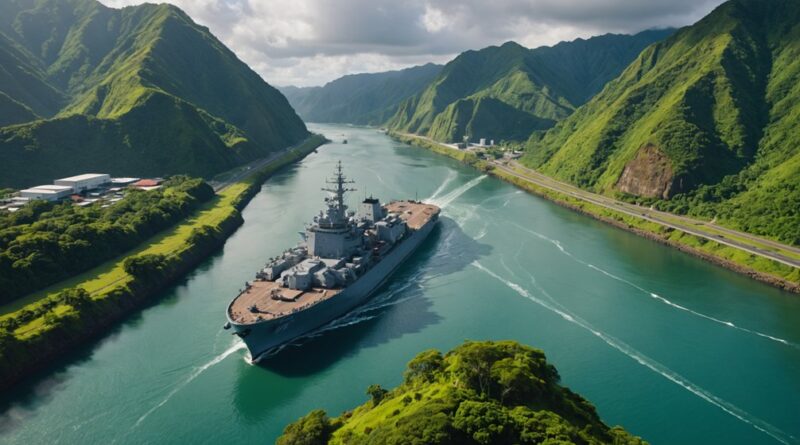
Why Was the Canal Across Panama So Important to the US Navy?
You rely on the Panama Canal as the U.S. Navy once did because it turned a long, dangerous trip around South America into a fast route between the Atlantic and Pacific. You could shift warships in days, not weeks, defend both coasts, support interventions in Latin America, and protect U.S. trade more efficiently. Even today, it shapes fleet movements, logistics, and strategy, and there’s more to how that influence continues.
Key Takeaways
- It created a strategic shortcut between the Atlantic and Pacific, enabling the U.S. Navy to shift fleets between oceans in days instead of weeks.
- The canal strengthened U.S. coastal defense and global reach by allowing rapid reinforcement of either seaboard or distant theaters.
- It underpinned enforcement of the Monroe Doctrine, supporting quick naval intervention and presence throughout the Caribbean and Latin America.
- The canal served as a vital chokepoint, letting the U.S. reposition destroyers, cruisers, and submarines efficiently between the 2nd, 3rd, and 4th Fleets.
- By shortening routes and lowering transit costs, it enhanced logistics and economic security, supporting naval operations tied to U.S.-bound maritime trade.
The Panama Canal’s Impact on U.S. Naval Power
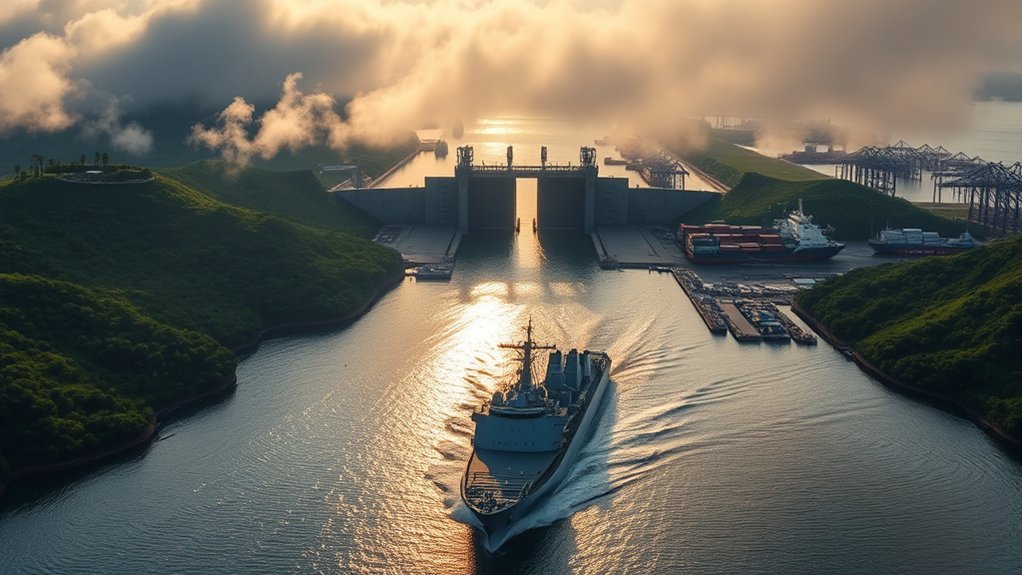
Although the Panama Canal once served as a strategic shortcut that bound America’s Atlantic and Pacific fleets into a single, flexible force, its direct impact on U.S. naval power has sharply diminished as ships and strategy have evolved. You used to depend on the canal to shift forces rapidly between oceans, especially in the first half of the 20th century. That ability underwrote your global reach, reinforced both coasts, and supported interventions across Latin America and beyond. Today, you operate a fleet whose most powerful assets can’t fit through it. Post–World War II aircraft carriers, including Nimitz‑ and Ford‑class ships, exceed canal limits, so none of your eleven carrier strike groups can transit. Modern tolls on commercial shipping through the canal now affect U.S. consumers far more than they influence your naval operations. Recent Navy use has dropped to just a handful of warship crossings over eight years, typically for one‑off movements like a new destroyer delivery. As a result, you no longer treat the canal as central to naval warfighting.
Panama Canal: The Navy’s Strategic Shortcut
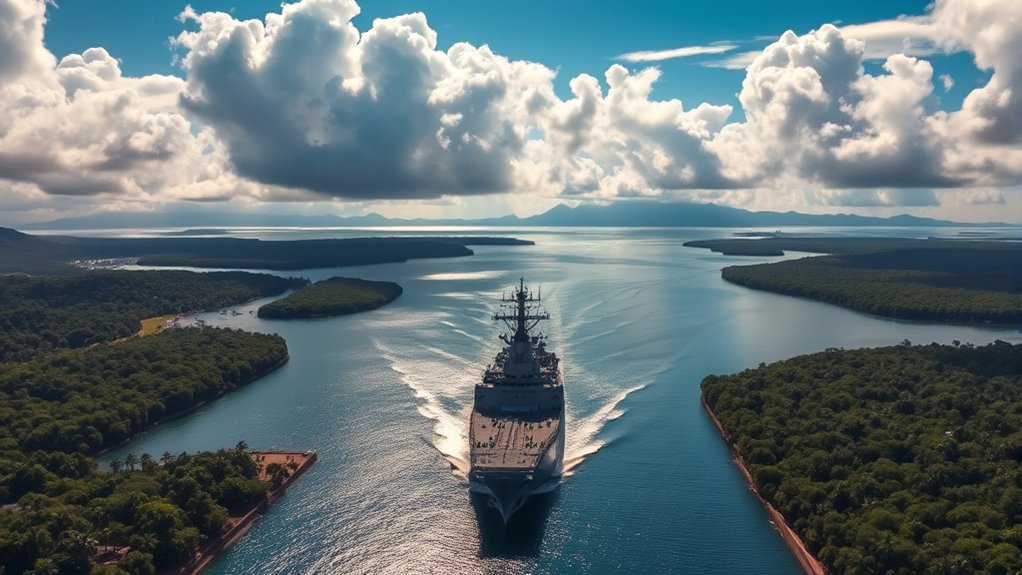
Even as its role in high‑end naval combat has faded, the Panama Canal still matters as a strategic shortcut that lets you move warships between the Atlantic and Pacific in days instead of weeks. Instead of sailing over 13,000 miles from New York to Pearl Harbor around Cape Horn, you cut the distance to about 6,700 miles. That saves more than 8,000 nautical miles and turns a month‑long voyage into a matter of days. As a result, the canal remains a critical tool of U.S. military strategy, allowing Washington to shift naval power between oceans without maintaining two fully independent battle fleets.
You avoid the treacherous seas off South America, reduce wear on destroyers, cruisers, and amphibious ships, and keep deployment schedules tight. Every time commercial traffic saves money, your logistics chain benefits too.
The canal’s only 50 miles long, but it demands precision: heavy warships squeeze through lock chambers, guided by tugs and locomotives. Modern carriers can’t fit, and Navy passages are rare, but the canal still quietly links your Atlantic commitments to your Pacific presence.
How the Canal Reshaped U.S. Fleet Basing and War Plans
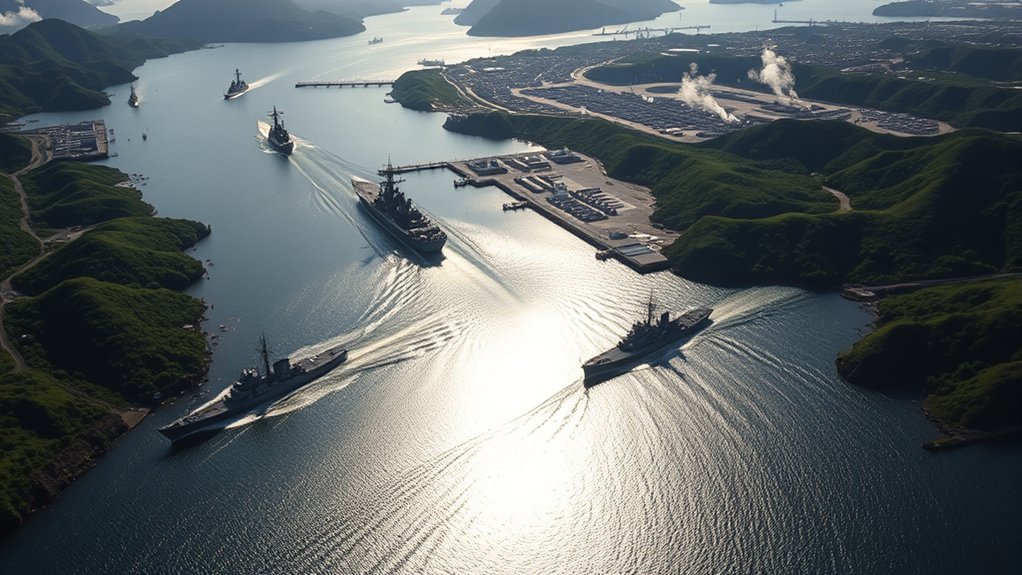
When the Panama Canal opened, it didn’t just shorten routes; it let U.S. planners redesign where they based the fleet and how they expected to fight. You no longer had to treat the Atlantic and Pacific as isolated arenas. Instead, you could plan on moving the same battle fleet between them, using the canal as an interior line that cut 8,000–10,000 miles off reinforcement routes and up to 40 days from some transits. This new mobility also made enforcing the Monroe Doctrine in the Caribbean and Latin America far more credible, because heavy ships could reach threatened areas much faster.
Strategists drew a new map in their heads. They concentrated most heavy forces in the Atlantic, where maintenance and training conditions were better, yet they still counted on meeting Pacific crises quickly.
The Pacific coast of Central America now lay closer to Panama than to San Francisco, so you could:
The Pacific side of Central America became a forward doorstep, reachable faster from Panama than California
- Rush Atlantic-based ships to threatened Pacific chokepoints
- Reinforce one ocean without stripping the other
- Shift peacetime basing and war plans from static defense to mobile concentration
Canal Trade, U.S. Economic Security, and Naval Influence
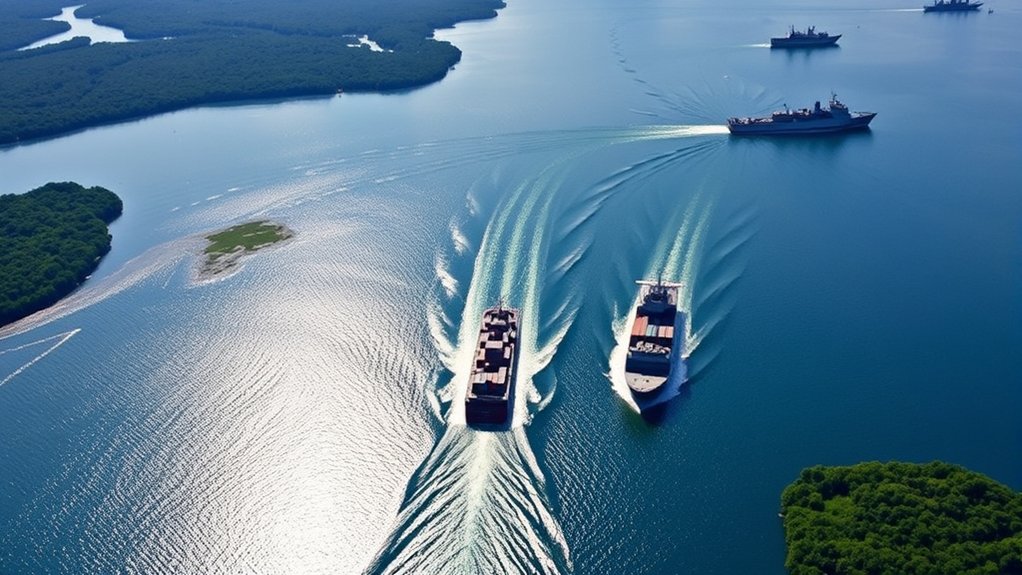
You can’t understand the U.S. Navy’s reliance on the Panama Canal without first seeing how its trade flows fuel American prosperity and maritime reach.
As you track the canal’s role in carrying a large share of U.S.-bound shipping, you also see how it underwrites economic security that policymakers equate directly with national security.
From there, you can examine how this commercial artery amplifies U.S. power projection, letting warships move quickly between oceans to protect the very trade that sustains the nation’s economy. In a major crisis, that same arterial route allows the Navy to swiftly redeploy ships between the Atlantic and Pacific, cutting weeks off potential detours around South America.
Canal Trade and Growth
Although it spans barely 50 miles across Central America, the Panama Canal shapes a disproportionate share of global commerce and, by extension, U.S. naval strategy.
You see its impact every time a ship avoids the 8,000‑mile detour around Cape Horn and instead crosses between oceans in hours, not weeks. About 5% of the world’s shipping—over 14,000 vessels a year—relies on this corridor, and roughly 72% of those transits link to U.S. ports. This concentrated flow of traffic through the canal makes it a strategic chokepoint for U.S. national security and naval planning.
You depend on the canal to move containers, LNG, vehicles, and refrigerated cargo quickly enough to sustain just‑in‑time supply chains and perishable trade.
Its time savings:
- Slash fuel costs.
- Lower freight rates coast‑to‑coast.
- Cut emissions while expanding U.S. and global market reach.
Maritime Power Projection
Maritime power projection turns the Panama Canal from a commercial shortcut into a strategic hinge for U.S. naval dominance.
You link the Atlantic and Pacific without sailing an extra 8,000 nautical miles or rounding Cape Horn’s 14,000‑mile route. You reposition warships between theaters in days, not weeks, and respond to crises faster while cutting fuel use, wear on hulls, and strain on crews.
You also gain direct access to key regions.
Destroyers, cruisers, and amphibious ships can shift quickly toward the South China Sea, Persian Gulf, or Caribbean, reinforcing alliances and presence.
Neutrality rules give your warships expedited, reliable passage in emergencies, while post‑2016 expansion—larger locks, deeper channels, added water reserves—boosts overall transit capacity and flexibility.
Economic Security Link
Linking oceans also ties directly into U.S. economic security, and that’s where the Panama Canal’s strategic weight really shows. When about 72% of transiting ships and over 70% of cargo link to U.S. ports, you’re looking at a chokepoint that quietly underwrites your daily economy.
The canal moves 5–6% of global maritime trade—hydrocarbons, minerals, cereals, containers, vehicles—at speeds and costs you can’t match by going around Cape Horn.
You feel its impact in:
- Faster, cheaper coast‑to‑coast and Asia–East Coast routes that sustain just‑in‑time supply chains and lower emissions.
- A trade system where disruption would hit U.S. growth and security instantly.
- Leverage to counter Chinese port influence and keep canal access aligned with U.S. naval and economic priorities.
Modern U.S. Warships, Limits, And Workarounds At The Canal
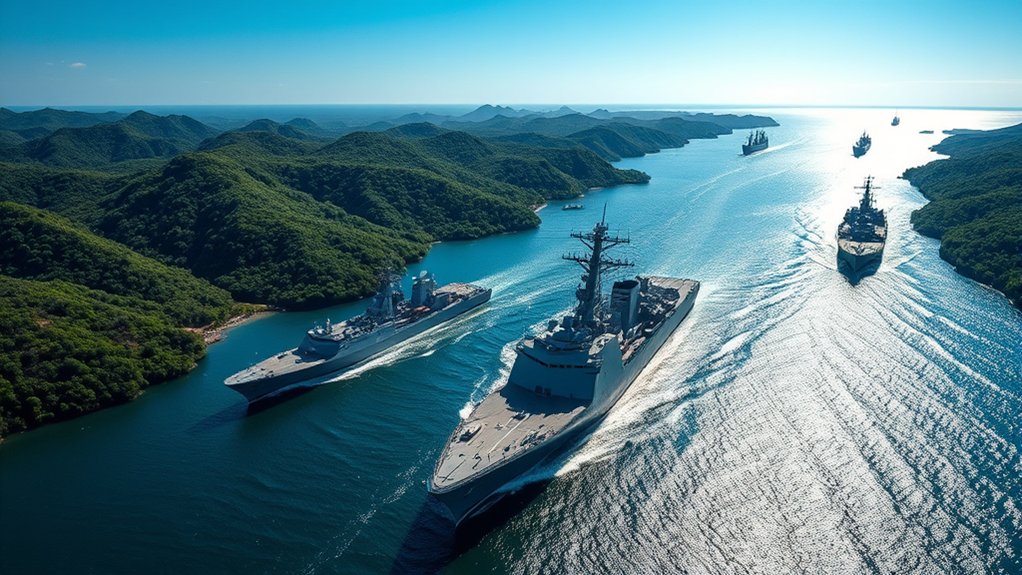
Even as the expanded Neopanamax locks have opened the canal to a new generation of giant merchant ships, they only partially accommodate modern U.S. warships and exclude the Navy’s most powerful assets. The new locks can handle ships up to about 51 meters wide and 366 meters long, but Nimitz‑ and Ford‑class carriers exceed these limits once you include their overhanging sponsons.
All eleven carrier strike groups must instead move between oceans via long, fuel‑intensive routes around South America or through other chokepoints.
You still see steady naval traffic, just not from carriers. Destroyers, cruisers, and submarines fit comfortably, especially in the original Panamax locks, which they’ve used for decades.
From 1998 to 2024, only 994 U.S. warships and subs—about 38 per year—transited the canal, a tiny fraction of overall traffic.
Recent agreements promise priority, expedited passage, and close security cooperation, even as neutrality rules formally bar open favoritism.
The Canal In Today’s Great‑Power Naval Strategy
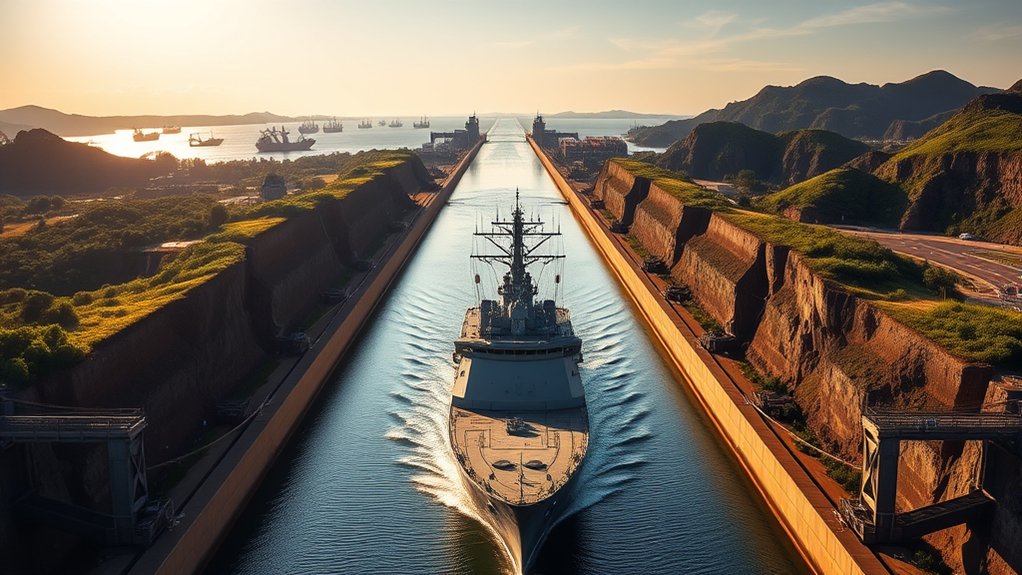
Although container ships and cruise liners dominate imagery of the Panama Canal today, its real strategic weight lies in how it underpins U.S. and allied naval mobility between the world’s main theaters of conflict.
Beneath the cruise ship imagery, the Panama Canal is a warfighting artery for U.S. and allied fleets
You rely on it as a strategic chokepoint that slashes over 8,000 nautical miles off a Cape Horn route and lets you shift combat power between the 2nd, 3rd, and 4th Fleets in hours instead of weeks.
In a potential Indo‑Pacific crisis, you’d use the canal to surge Atlantic‑based ships toward China, cutting New York–Pearl Harbor distance nearly in half and preventing late arrivals that could decide a campaign’s outcome.
You also treat the canal as an economic‑security lever:
- 70% of its traffic is U.S.-related.
- 42% links Asia and the U.S. East Coast.
- $270 billion in annual cargo underpins your wartime sustainment.
Frequently Asked Questions
How Did Disease Control During Construction Affect the Canal’s Naval Viability?
Disease control made the canal naval‑viable by ensuring timely completion, sustaining a large workforce, and preventing epidemics. You gained a reliable, year‑round shortcut for rapid fleet shifts, fuel‑efficient operations, and dependable crisis deployments between oceans.
What Specific Treaties Guaranteed U.S. Navy Access to the Canal?
You rely on the Hay–Pauncefote, Hay–Bunau-Varilla, Taft arbitration–related agreements, and the 1977 Neutrality Treaty. Together they guaranteed, clarified, and preserved your Navy’s perpetual, fortified, and neutral access for wartime and peacetime operations.
How Is the Canal Defended Against Sabotage or Cyberattacks Today?
You’d see the canal protected by layered fences, patrols, cameras, and intrusion sensors, plus radar, drones, and underwater systems, while a dedicated cyber team uses firewalls, MFA, backups, and US–Panama intelligence sharing to counter sophisticated attacks.
Did the Canal Influence U.S. Marine Corps Amphibious Warfare Doctrine?
Yes, it did. You treat the canal as a strategic shortcut that makes rapid cross-ocean reinforcement feasible, so you design amphibious doctrine around swift theater shifts, fuel-efficient movements, and staging forces for distant littoral assaults.
How Do Environmental Regulations at the Canal Affect U.S. Naval Operations?
They constrain your transit timing, limit daily passages, and prioritize environmentally compliant ships. You must plan deployments around drought-driven water restrictions, lock availability, traffic congestion, and hull-size or emissions rules that can reroute or delay carrier groups and support vessels.
Conclusion
You can see how the Panama Canal turned from a bold engineering gamble into the backbone of U.S. sea power. It let the Navy rush forces between oceans, protect trade, and back up American diplomacy with real muscle. Even as modern warships sometimes outgrow its locks, you still plan and posture around this narrow hinge of global strategy. If you care about naval power, you can’t ignore Panama.