What Are the Advantages and Disadvantages of Screws?
Screws give you strong holding power, precise alignment, and long‑term stability, especially when joints see pull‑out forces or need later adjustment. You can tighten, remove, and reposition them without damaging materials as much as nails. However, they cost more, install slower, and can perform worse than nails in high shear or heavy impact situations. They also need careful selection for corrosion resistance. If you go further, you’ll see when screws truly outperform other fasteners.
Key Takeaways
- Screws provide superior holding power and load distribution, especially for pull-out forces, making them ideal for weight‑bearing and pull-apart joints.
- Their threaded design allows precise adjustment, easier error correction, and disassembly, giving more control than nails or many other fasteners.
- Installation is slower and often more skill‑intensive than nailing, sometimes requiring pilot holes and careful alignment, especially in hardwoods.
- Screws can be weaker in pure shear, may loosen under vibration, and are susceptible to fatigue cracking at the threads under cyclic loading.
- Corrosion-resistant options (stainless, galvanized, coated) offer long-term durability, but low-quality or unprotected screws can fail in moist or chemically harsh environments.
Screws vs Nails: Which Fastener Holds Best?
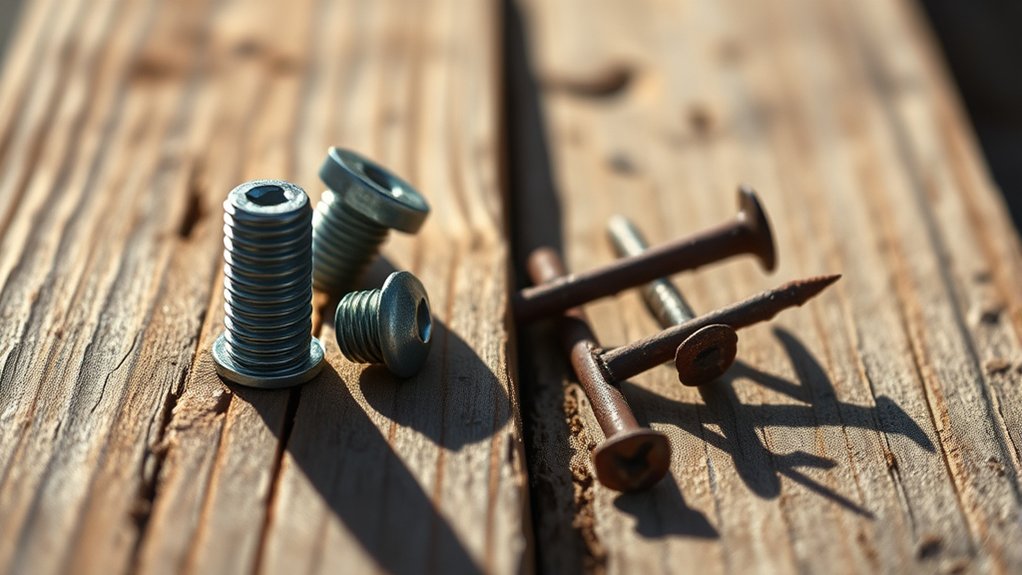
When you’re deciding between screws and nails, “holding best” depends on how the force hits the fastener—sideways or straight out.
Under side-to-side, or shear, loads, nails usually win. They’re softer steel, so they bend instead of snapping, which helps when wind or movement pushes framing members past each other. That’s why you’ll often see nails securing joists and other structural connections that face considerable lateral pressure.
When the force tries to pull the fastener straight out, screws hold better. Their threads bite into the wood, so they resist withdrawal far more than smooth or ring-shank nails. Because of this higher tensile strength, screws are generally the better choice for joints that may be pried apart or lifted over time.
Under straight pull-out force, screws win—threads bite into wood and resist withdrawal far better than nails.
In tests, deck screws can deliver nearly triple the pull-out strength of even the strongest nails, and drywall screws greatly outperform ring-shank nails on a per-penny basis.
Why Screws Offer Superior Holding Power and Durability
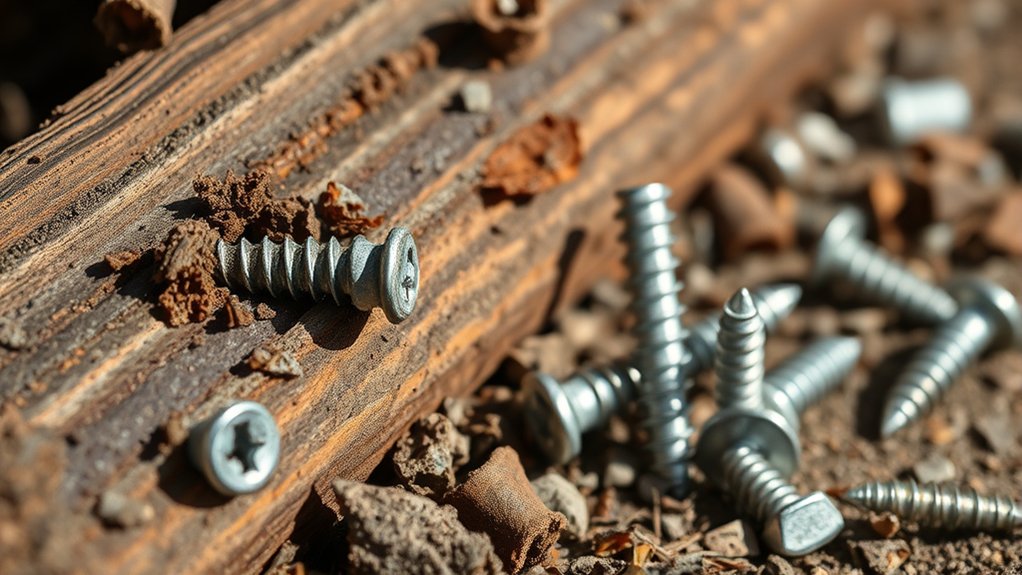
When you compare screws with other fasteners, you’re really comparing how their thread design grips material, how they hold up over time, and how well they resist corrosion.
You’ll see that the helical threads don’t just bite into the material; they lock in place to provide long-term structural stability under repeated loads.
Add modern corrosion-resistant coatings and materials, and you get a fastener that maintains its holding power and integrity far longer in real-world conditions. Screws also allow for easy adjustability, so you can tighten, loosen, or completely remove them without significantly damaging the surrounding material.
Thread Design and Grip
Although a screw may look simple from the outside, its real holding power comes from the engineered geometry of its threads. You gain grip because standard, ACME, and rolled threads increase root strength and resist stripping, while fine and coarse pitches let you trade tension strength for stripping resistance as needed. By selecting screw threads designed for high axial thrust, like buttress profiles in heavy clamping or linear drive applications, you can safely transmit large one-directional forces without premature wear or failure.
By choosing the right profile, you control how deeply the threads bite and how loads spread through the joint.
- Fine and rolled threads give you higher tensile capacity, better fatigue life, and stronger torsional shear at a given diameter.
- Coarse, Hi-Low, and forming threads maximize bite in wood and plastics without splitting or stress cracking.
- Precision fits and tight tolerances distribute load evenly, cutting wear and resisting vibration-driven loosening.
Long-Term Structural Stability
Thread geometry gives a screw its bite, but long-term structural stability comes from how that bite holds up under real-world loads and environments. When you use structural screws, they distribute loads across more material, so no single area takes all the stress. That’s why they resist pullout, pull-through, stripping, and shear better than many traditional fasteners. By enhancing overall reliability, this even load distribution ensures components remain fixed over time, even in projects with regular movement.
You also gain tighter joints. As you drive a screw, it clamps components together, closing gaps and reducing movement. Longer, wider screws grip deeper, while washer heads spread force to prevent pull-through.
In demanding applications, high-strength materials and measurable torque give you predictable, code-compliant performance. Structural screws often replace hurricane ties and nail plates, delivering faster installation while still providing durable, load-bearing connections over the structure’s life.
Corrosion Resistance Benefits
Because screws can be engineered with specific corrosion-resistant materials and coatings, they keep their strength and grip far longer than many alternative fasteners.
Stainless steel screws use chromium to form a self-healing oxide layer, so A2 and A4 grades withstand acidic timbers, industrial pollution, and even marine spray, while HCR grades endure the harshest chloride-rich sites.
Galvanized screws add a thick, sacrificial zinc layer that resists weather on decks, roofs, and structural framing, even when scratched. This sacrificial action is especially important in high‑humidity environments, where moisture and airborne salts would otherwise accelerate corrosion.
Zinc-plated options give moderate protection for dry, non-marine jobs.
To choose correctly, you’ll weigh:
- Environmental exposure (indoor, coastal, industrial, or poolside).
- Timber chemistry (acidic, tannin-rich, or treated).
- Service life expectations versus material and coating cost.
Installation: Screws vs Nails and Bolts
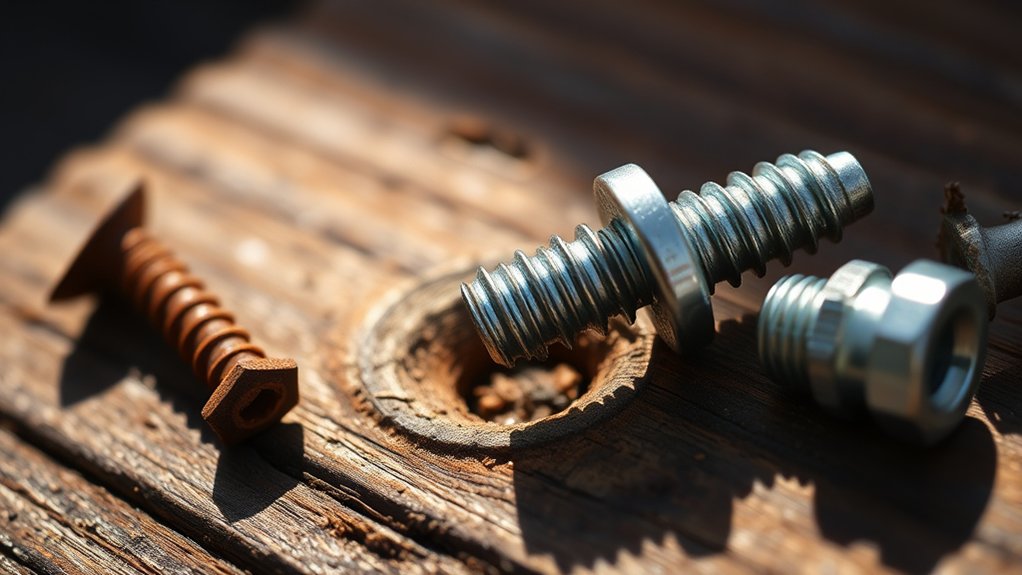
When you compare screws to nails and bolts, you have to balance speed and labor effort against control and convenience.
You’ll notice that different tools and skill levels change how quickly you can work and how tired you get.
You also need to think about how much precision and adjustability your project demands, especially if you expect to make changes later.
Speed And Labor Effort
Although screws often feel more “deliberate” and controlled during installation, they typically can’t match the raw speed and low labor effort of nails, especially on large framing or siding jobs.
Driving a screw needs rotational force, careful aiming, and often pre‑drilling, so each fastener eats more time and energy than a quick hammer blow or a blast from a nail gun.
When you compare fasteners strictly on speed and labor, you can think of them this way:
- Screws vs nails: screws give you control but slow you down, especially when you’re installing hundreds or thousands.
- Nails excel where repetitive, rapid fastening matters more than precision.
- Screws still beat bolts, since they don’t need nuts, wrenches, and painstaking alignment.
Tools And Skill Needed
Speed isn’t the only difference you’ll notice between screws, nails, and bolts—what you need in your hands and how steady your technique is matter just as much.
With screws, you’ll usually reach for a drill or impact driver plus the right driver bit; choose wrong, and you’ll strip the head. In hardwoods, you’ll often drill pilot holes, and you’ve got to manage torque so you don’t over-drive or snap anything.
Nails stay simpler. A hammer and a handful of nails will handle most light wood work, and a nail gun speeds up framing or roofing without much added skill.
Bolts demand the most setup. You’ll drill accurate holes, then tighten nuts with wrenches or sockets, often adding washers for better load spread.
Precision And Adjustability
Long before you worry about strength or speed, screws set themselves apart by how precisely you can place and adjust them compared with nails and bolts.
With a driver, you meter in torque instead of guessing with a hammer blow, so depth and clamping force stay consistent. Precision screws go even further: high‑precision machining, fine threads up to 508 TPI, and ball or square threads give you micrometer‑level motion and repeatable positioning.
You feel the difference when you need controlled adjustability instead of a one‑shot fix. Screws let you loosen, tweak, and retighten without destroying the joint or surrounding material.
- You control position and preload accurately.
- You correct errors instead of living with them.
- You achieve cleaner, lower‑profile installations.
Using Screws in Wood, Metal, Drywall, and More
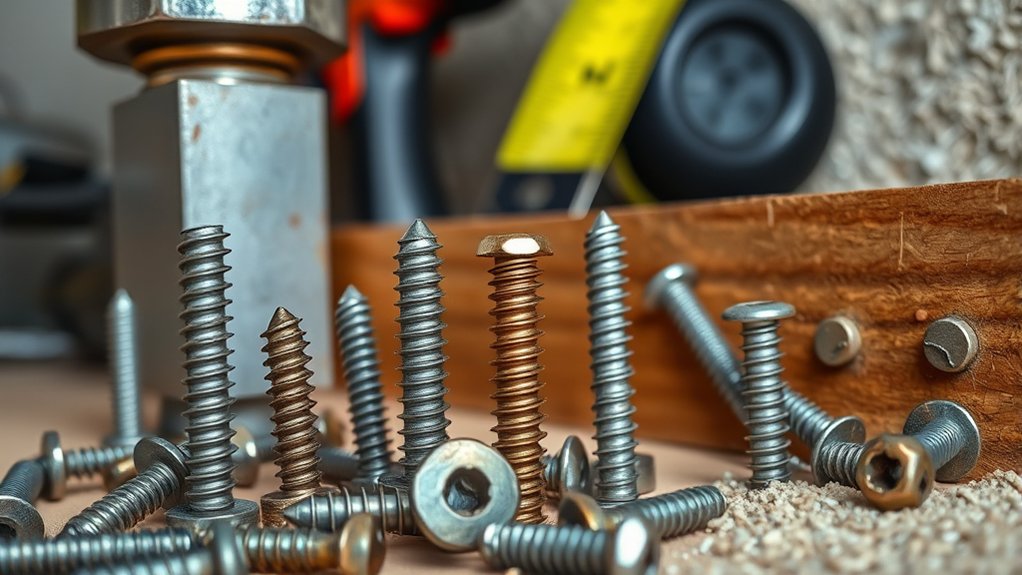
Whether you’re fastening framing lumber, hanging drywall, or joining light metal, choosing the right screw type and thread pattern directly affects strength, durability, and ease of installation. In wood, you’ll get the best results with wood screws: coarse threads and tapered, thicker shanks bite firmly and resist shear, whether you’re working in softwoods, hardwoods, plywood, or MDF. Different head styles and corrosion‑resistant coatings let you match both strength and appearance to the job.
In drywall, use dedicated drywall screws. Their sharp, self‑drilling tips speed installation, while bugle heads sink flush without tearing the paper. Choose coarse threads for wood studs and fine threads for metal studs.
For metal, fine‑thread screws grip better and strip less. Fully threaded shanks keep thin sheet metal from deforming.
| Material/Task | Recommended Screw Features |
|---|---|
| Structural wood | Coarse, tapered wood screws |
| Exterior wood | Galvanized / stainless |
| Drywall to wood | Coarse‑thread drywall screws |
| Drywall to metal | Fine‑thread drywall/metal screws |
When Screws Don’t Work Well (Limitations to Know)
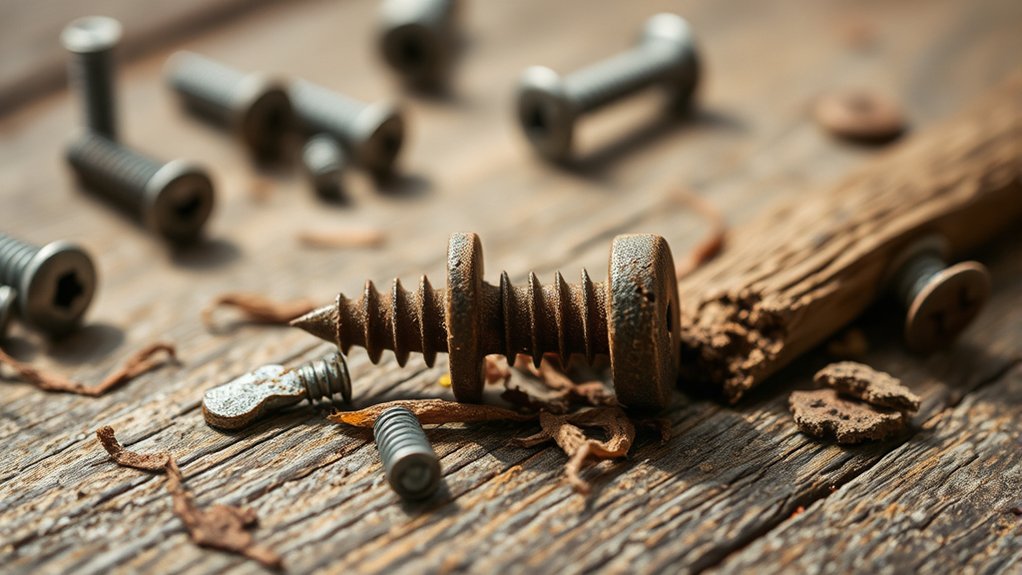
Although screws are incredibly versatile, they’re not the right choice for every job—and forcing them into the wrong application can lead to weak joints, damage, or outright failure. Their main strength is grip in the pulling (tensile) direction, but they’re weaker in sideways (shear) loads than nails, which can flex instead of snapping.
In heavy structural or high-shear situations, screws may crack, break, or split the top material.
Vibration and environmental exposure add more limits. Constant movement, thermal expansion, and cyclic loading slowly loosen screws or trigger fatigue cracks at the threads.
Moisture, salt, or chemicals can corrode low‑quality or poorly chosen screw materials until they lose holding power or fail completely.
To decide whether screws are appropriate, think regarding:
- Direction and magnitude of loads.
- Level and type of vibration or movement.
- Environmental exposure over the fastener’s lifetime.
How to Choose Between Screws, Nails, and Bolts for Your Project?
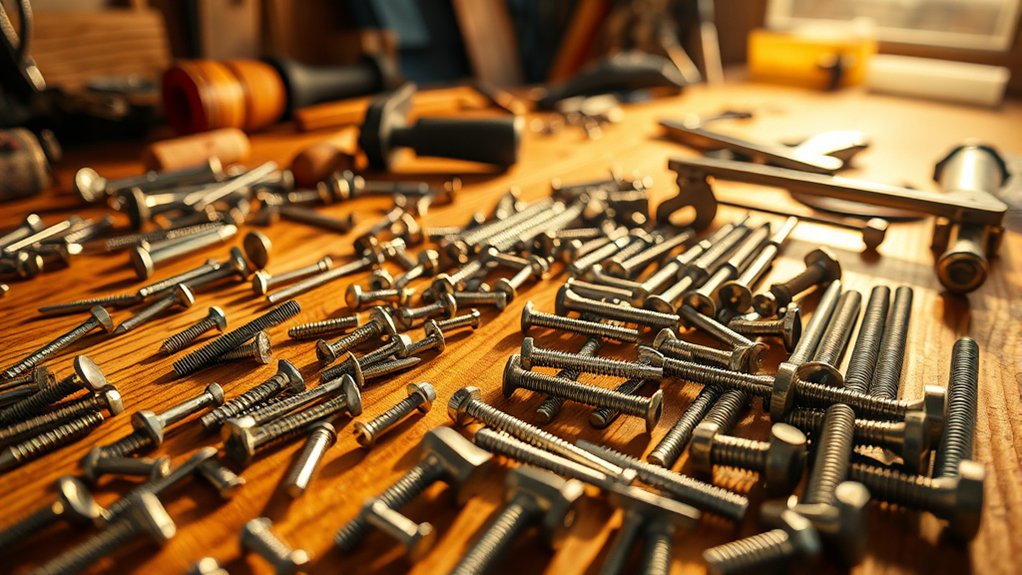
How do you decide if a job calls for screws, nails, or bolts instead of just grabbing whatever’s handy? Start by asking what kind of force the joint will face.
If pieces might pull apart or bear weight—like porch railings, shelves, or kitchen cabinets—choose screws. Their threads bite into the material and act like tiny pawls, giving far better grip and withdrawal resistance than nails.
If the main force is sideways shear—like wall framing or simple blocking—nails are usually better. They’re cheaper, faster to drive, and flex under load instead of snapping like screws.
Next, consider access and future changes. If you’ll disassemble, adjust, or move the project—furniture, jigs, modular builds—use screws or, for larger members, bolts with nuts.
Bolts step in when stock gets thick, loads get heavy, or you need serious clamping power you can tune with a wrench.
Frequently Asked Questions
Are Screws or Nails More Environmentally Friendly and Recyclable?
You can’t definitively say screws or nails are greener; both are usually recyclable steel. You’ll reduce impact most by reusing fasteners, minimizing waste, choosing uncoated or low-toxicity finishes, and recycling metal with local scrap facilities.
What Safety Precautions Should I Follow When Working With Screws?
You should wear PPE, inspect and unplug tools, secure workpieces, pre‑drill hard materials, align and don’t over‑tighten screws, choose compatible corrosion‑resistant types, test on scrap, maintain a firm grip, and always work in good lighting.
How Do I Store Screws to Prevent Rust and Loss of Strength?
You prevent rust and strength loss by storing screws dry below 50% humidity in sealed, labeled containers with desiccants. Use coated or stainless screws, keep them off damp floors, control temperature, and rotate stock using FIFO.
Which Screw Head Types Are Best for Preventing Stripping?
You prevent stripping best with Torx or Stick-Fit heads because they grip tightly and avoid cam-out. Next best, use Pozi for higher torque than Phillips. Avoid Phillips for demanding jobs or hard materials when possible.
Can I Use Decorative Screws Where Appearance Is Important?
Yes, you can. You’ll get polished finishes, matching colors, and stylish head shapes that suit visible areas. Just don’t rely on them for heavy structural loads, harsh environments, or sloppy countersinking where safety matters.
Conclusion
When you’re choosing between screws, nails, and bolts, start with how strong you need the connection to be and what materials you’re joining. Screws usually give you better grip, easier removal, and long‑term reliability, especially in wood, metal, and drywall. But they’re not perfect—vibration, extreme loads, or very soft materials can favor nails or bolts. If you match the fastener to the job, you’ll build projects that last and stay safe.