Who Were the Three Sons of Herod the Great?
You’ll meet Herod the Great’s three ruling sons all over the New Scriptures’ background. After Herod died, Rome split his kingdom: Archelaus ruled Judea and Samaria as ethnarch, Antipas ruled Galilee and Perea as tetrarch, and Philip ruled the quieter northern regions like Iturea and Trachonitis. Archelaus’s brutality, Antipas’s schemes with John the Baptist and Jesus, and Philip’s stability all shape the Gospels’ political stage, and there’s more to uncover about each.
Key Takeaways
- Herod the Great’s realm was divided among three sons: Archelaus, Antipas, and Philip, after his death in 4 BCE under Roman oversight.
- Herod Archelaus became ethnarch over Judea, Samaria, and Idumea, ruled brutally, and was deposed and exiled by Rome in 6 CE.
- Herod Antipas became tetrarch of Galilee and Perea, executed John the Baptist, mocked Jesus during His trial, and was exiled in 39 CE.
- Herod Philip ruled the northern territories (including Iturea and Trachonitis) as tetrarch, administering quietly and effectively for 37 years until his death in 34 CE.
- These three sons’ divided rule shaped the political and religious context of the New Testament, influencing events in Jesus’ life and early Christian history.
How Herod the Great’s Kingdom Was Divided
When Herod the Great died in 4 BCE, his vast client kingdom didn’t pass to a single heir but was broken into a Herodian tetrarchy under Roman oversight. You need to picture Rome in charge at the top, with Herod’s family ruling only by imperial permission. Augustus Caesar reviewed Herod’s competing wills, heard the heirs’ disputes, then ratified a compromise division. This reshaped the political landscape for the three sons of Herod the Great who inherited portions of his realm.
You see four main recipients.
Herod Archelaus, the preferred heir in Herod’s final will, became ethnarch over Judea, Samaria, and Idumea, including Jerusalem and Bethlehem, effectively holding about half the kingdom with higher rank than his brothers.
Herod Antipas, originally favored in an earlier will, received Galilee and Perea as tetrarch, about a quarter of the territory.
Philip, son of Cleopatra of Jerusalem, became tetrarch over the northern districts east and north of the Sea of Galilee.
Their sister Salome I received a smaller domain, later absorbed into direct Roman administration.
Why Herod’s Sons Matter in the New Testament

When you track Herod’s sons across the Gospels, you see how they shape the political map on which Jesus’ story unfolds—from Bethlehem and Judea to Galilee and beyond. Their shifting territories, titles, and loyalties form the real-world backdrop for events like the flight to Egypt, John the Baptist’s execution, and Jesus’ trial. As you follow these rulers, you also see how their actions frame the New Covenant’s presentation of fulfilled prophecy about oppression, exile, and God’s promised deliverance. Their rule is part of a broader Herodian dynasty marked by political intrigue, violent power struggles, and collaboration with Rome.
Shaping The Gospel Landscape
Though the New Covenant rarely pauses to explain them, Herod the Great’s sons quietly shape the entire Gospel context. When you watch Joseph divert from Bethlehem to Nazareth, you’re already feeling Archelaus’s brutality push the Messiah’s family to the margins. His brief ethnarchy helps explain why Jesus grows up far from Judea’s power center. His later removal in 6 CE and the conversion of his lands into a Roman province deepened direct imperial control over Judea.]
You also move through Antipas’s world every time you read about Galilee. His execution of John the Baptist, his marriage to Herodias, and his wary encounter with Jesus color how you see prophetic courage and cynical authority.
Philip’s long, quieter rule in the north stabilizes regions like Iturea and Trachonitis, providing the settled backdrop for later mission fields and for the rise of Herod Agrippa I in Acts.
Political Backdrop To Jesus
Even before Jesus begins preaching, Herod the Great’s sons have already drawn the political map that shapes His world. You navigate the Gospels against this fractured backdrop: Archelaus over Judea and Samaria, Antipas over Galilee and Perea, Philip ruling far to the north. Each “Herod” you meet isn’t a random tyrant but part of a coordinated, family-based power system. This same dynasty would later produce Herod Agrippa I, whose violent persecution of early Christians shows how deeply the family remained entangled with the church’s story.
| Region / Ruler | Why it matters to you when reading |
|---|---|
| Archelaus – Judea, Samaria | Explains Joseph avoiding Bethlehem after Egypt. |
| Antipas – Galilee, Perea | Frames Jesus’ ministry base and later trial. |
| Philip – Northern territories | Sets context for border-area ministry. |
| Salome’s holdings | Show Rome’s quiet expansion. |
| Roman governors after Archelaus | Lead directly to figures like Pilate. |
Fulfillment Of Prophecy Context
Archelaus’s rule over Judea makes Joseph fear returning to Bethlehem, pushing the family to Galilee and tying Jesus to Nazareth after the Egypt return that echoes Hosea 11:1.
Antipas’s long reign in Galilee and Perea gives Jesus a relatively stable base for ministry, even as this “fox” executes John the Baptist and later mocks Jesus during His trial—fitting the pattern of a suffering Messiah.
Philip’s quieter tetrarchy rounds out the Herodian map, while Archelaus’s removal opens the door to direct Roman rule in Judea at the climactic moment.
Herod Archelaus: Ethnarch of Judea and Samaria
As you turn to Herod Archelaus, you’re looking at the son who inherited half of Herod the Great’s kingdom and yet couldn’t hold it for even a decade.
You’ll trace how he rose as ethnarch over Judea and Samaria under Roman approval, ruling a vast yet fragile territory.
Then you’ll see how his brutality triggered his deposition and cleared the way for direct Roman rule that reshaped the political world of the New Scriptures.
Rise To Ethnarch
Although Herod Archelaus rose higher than any of his brothers in Herod the Great’s final settlement, his path to power was abrupt, contested, and fragile from the start.
You see him emerge from relative obscurity as the son of Herod and the Samaritan Malthace, only gaining precedence when Antipater’s execution in 4 BCE toppled the previous heir.
Herod’s revised will suddenly placed Archelaus over his full brother Antipas and their half‑brother Philip.
You watch Augustus step in, honor the division, yet withhold the royal title.
Instead of “king,” you find Archelaus confirmed merely as ethnarch over Judea, Samaria, and Idumea—half the kingdom, including Jerusalem, but under Roman oversight and amid fierce family rivalry and popular unrest.
Deposition And Roman Rule
Even with the impressive title of ethnarch and control over half his father’s domain, Herod Archelaus never held power on secure terms, and Rome ultimately decided his fate.
You’ve already seen how his client-king status left him vulnerable; now you watch that fragility play out. Archelaus’s harsh rule alienated Jewish subjects and frustrated Roman expectations of stability. Complaints piled up in Rome, convincing Augustus that the ethnarch couldn’t manage Judea, Samaria, and Idumea.
In 6 C.E., Augustus deposed Archelaus and exiled him, offering no compensating honor. Rome immediately converted his territories into the province of Judea, governed directly by Roman prefects such as Pontius Pilate.
With that shift, you see Herodian dynastic power shrink while Roman imperial control tightens decisively.
Herod Archelaus’ Short Rule and Downfall
Herod Archelaus burst onto Judea’s political stage in 4 BC with a show of royal confidence that quickly dissolved into bloodshed and mistrust.
You watch him ascend a golden throne before Passover, dressed in white, promising tax relief and prisoner releases. When crowds demand justice for the slain teachers and youths and a more pious high priest, he sends soldiers instead of going himself.
Stones fly, troops charge, and about 3,000 die in the temple courts; Passover stops amid bloodstains.
Stones arc through sacred air, soldiers storm the courtyards, and Passover collapses under 3,000 lifeless bodies
You then see his rule unravel:
- He sails to Rome, pleads at Augustus’ feet, and returns only as ethnarch, not king, over a reduced territory.
- He copies Herod the Great’s brutality—heavy taxes, priestly meddling, and a scandalous marriage—fueling uprisings.
- Jewish leaders finally petition Augustus; Rome deposes Archelaus in 6 CE, turns his lands into provinces, and exiles him as a warning against tyrannical rule.
Herod Antipas: “The Fox” of Galilee and Perea

His long, relatively peaceful tenure, especially beside Archelaus’ collapse, explains why later memory tagged him “that fox”:
a cautious, calculating survivor in Rome’s shadow.
Herod Antipas, John the Baptist, and Jesus’ Trial
Although he governed longer and more smoothly than his brothers, Antipas steps into the Gospels’ spotlight above all through two explosive encounters: his conflict with John the Baptist and his brief, chilling role in Jesus’ trial.
You see him most clearly at three moments:
- John publicly condemns Antipas for divorcing his first wife and marrying Herodias, his niece and sister‑in‑law—an unlawful union under Jewish law. Herodias, hungry for power, pushes for John’s death.
- At Machaerus fortress, Antipas imprisons John. After Salome’s dance and his rash oath, he orders John beheaded, a scene preserved in Matthew 14:1–12 and remembered as a turning point in his rule.
- During Jesus’ trial, Pilate sends Jesus to Antipas, ruler of Galilee and Perea. Antipas mocks him, dresses him in a robe, and returns him to Pilate—the only recorded meeting between Jesus and any Herod.
Herod Philip: The Quiet Northern Herodian Ruler

Quiet competence defines Herod Philip, the least famous yet longest‑ruling of Herod the Great’s surviving sons. You first need to distinguish him from Herod Philip I (Herod the Younger); this Philip is the son of Cleopatra of Jerusalem, likely born between 26 and 20 BCE. Herod the Great granted him royal status, and when the kingdom split in 4 BCE, Philip received the northeastern quarter.
You should picture his tetrarchy stretching across Iturea, Trachonitis, and Gaulanitis—northern Israel, Lebanon, and southern Syria—large, mostly Gentile, and economically modest. As a client ruler under Rome, he governed quietly but effectively for 37 peaceful years.
Unlike his more theatrical brothers, you’d see Philip constantly on the road in his territories, not in Rome, known as a just, peace‑loving administrator.
From his capital, Caesarea Philippi, he expanded a pagan town and its temple complex. Dying childless in 34 CE, he left a rare Herodian legacy: stability.
Salome, Herodias, and the Herodian Family Web Around Jesus
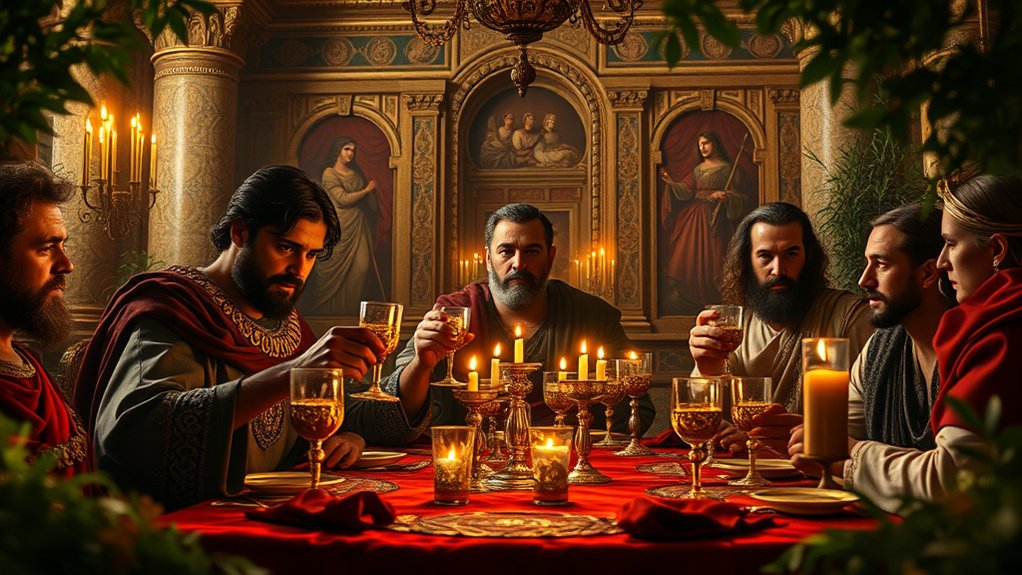
Even more than borders and titles, it’s the Herodian marriages that tangle closest around the story of Jesus. You can’t follow Herod’s three sons without also tracing Salome, Herodias, and the women who stitched the dynasty together.
Herod’s sister Salome I received Jamnia, Azotus, and Phasaelis after his death, briefly ruling alongside Archelaus, Antipas, and Philip before Rome absorbed her territory. Through her, another Salome would step into the Gospel story.
Herodias, Herod’s granddaughter, first married her uncle Herod Philip (a non-ruling son), then left him for his half‑brother Antipas. That scandal set John the Baptist against them and led to his execution.
Herodias’s forbidden marriage to Antipas ignited John the Baptist’s fury—and ultimately cost him his head
Herodias’s daughter Salome—your “Salome the dancer”—stands at the crossroads of politics and piety:
- She dances for Antipas.
- She requests John’s head.
- She later marries Philip the Tetrarch, binding the northern domain to this deadly story.
From Herod’s Sons to Agrippa I: What Happened Next

Once Herod the Great died, his kingdom didn’t simply fade; it fractured, shifted, and slowly slid into Rome’s hands.
You’d see Archelaus take Judea, Samaria, and Idumea as ethnarch, ruling harshly until Rome deposed and exiled him to Gaul in 6 CE, turning his lands into a Roman province.
You’d watch Antipas govern Galilee and Perea as tetrarch, the “fox” Jesus mentions. His unlawful marriage to Herodias led to John the Baptist’s death, and he later appears in Jesus’ trial.
Caligula finally exiled him to Gaul in 39 CE.
Far quieter, Philip ruled the northern districts—Iturea, Trachonitis, and more—with stability until his death in 34 CE; his lands went to Agrippa I, Herod’s ambitious grandson.
Frequently Asked Questions
How Do Herod’s Three Sons Compare to Herod the Great in Personality and Ability?
You see Herod’s sons echo him unevenly: Archelaus copies his brutality without his skill, Antipas mimics his cunning yet proves weaker, while Philip rejects his violence, ruling calmly but never matching his father’s political impact.
What Archaeological Sites Today Are Linked Directly to Each of Herod’s Three Sons?
You won’t find clear, securely identified sites for Archelaus, Antipas, or Philip like Herod the Great’s. Archaeologists mainly connect them indirectly: Antipas with Sepphoris/Tiberias; Philip with Caesarea Philippi; Archelaus with expanded Jerusalem/Jericho.
How Did Ordinary Judeans View Each Son Compared to Roman Historical Opinions?
You’d see Archelaus as a feared butcher, while Romans still honored his status. You’d resent Antipas’s scandal and John’s execution, though Rome viewed him administratively. You’d respect Philip’s calm fairness, matching Rome’s praise for his peaceful stability.
Did Any of Herod’s Three Sons Ever Directly Meet or Interact With Each Other?
You don’t have clear evidence that Herod’s three ruling sons ever directly met. Ancient sources don’t record specific encounters, though their succession dispute and intertwined marriages mean you can safely assume indirect awareness and political interconnection.
How Accurately Do Modern Films and Novels Portray Herod’s Three Ruling Sons?
They’re partly accurate. You usually see Archelaus as cruel, Antipas entangled with John and Jesus, and Philip calm. You don’t see full political nuance, frequent Philip mix‑ups, or quieter figures like Salome I.
Conclusion
When you trace Herod the Great’s three sons, you see how their divided rule shapes nearly every political scene in the Gospels. You watch Jesus, John the Baptist, and the early church move through a world these rulers control. As you follow Archelaus, Antipas, Philip, and their heirs, you’re not just learning history—you’re seeing how God works through messy dynasties, broken leaders, and shifting borders to advance a very different kind of kingdom.