How Big Is a 5 Lb Bag of Flour? Size and Volume Explained
A 5 lb bag of flour gives you about 18–19 cups of all-purpose flour, though type matters: cake flour yields more (up to ~22 cups), while whole wheat gives less (~15–17 cups). In weight, that’s 80 oz or about 2,270 grams. To store it, you’ll want roughly a 6-quart airtight container, which offers enough room to scoop. If you want to choose the right container and measure more accurately, there’s more to know.
Key Takeaways
- A 5 lb bag of all-purpose flour is about 18–19 cups; other types range roughly 15–22.5 cups depending on density.
- In weight, 5 lb of flour equals 80 ounces or about 2,270 grams, regardless of flour type.
- For storage, choose a 6-quart airtight container; 4.5–6 quarts is the ideal capacity range.
- A 5-quart container can fit 5 lb of flour but leaves little headroom, making scooping less convenient.
- Volume varies with packing and sifting; sifted flour can expand 10–15%, affecting how much fits in a container.
How Many Cups Are in a 5 Lb Bag of Flour?
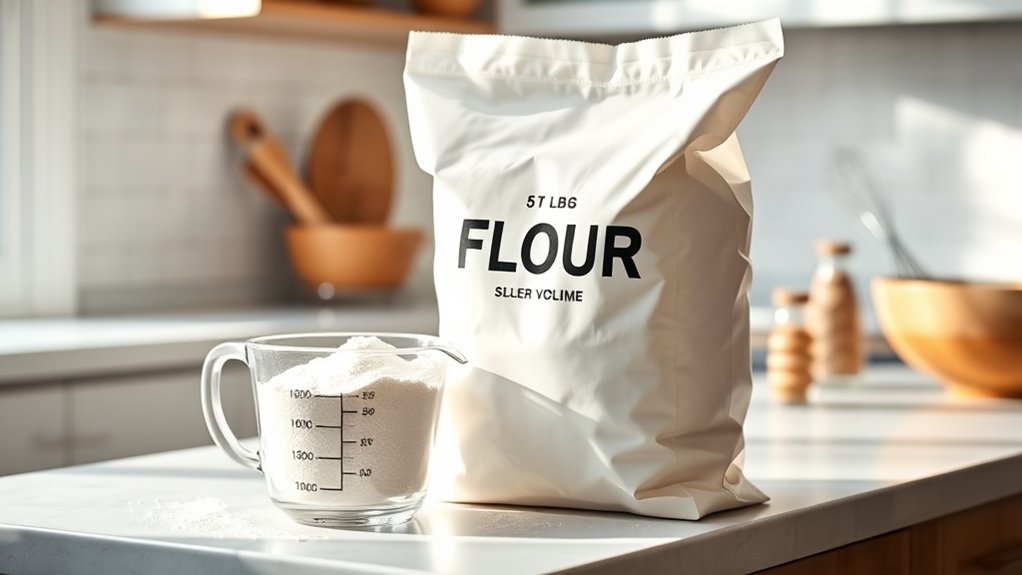
When you’re measuring from a standard 5-pound bag of flour, the exact number of cups depends on the type of flour you’re using. A 5-pound bag always weighs 80 ounces, but each flour packs differently, so every cup doesn’t weigh the same. Using a kitchen scale instead of relying on cup measurements helps ensure more consistent results, especially for baking.
With all-purpose flour, 1 cup weighs about 4.25 ounces. If you divide 80 by 4.25, you get about 18.8 cups, usually treated as just under 19 cups, or roughly 18 cups using 3.6 cups per pound.
Bread flour’s denser. At about 4.5 ounces per cup, 80 divided by 4.5 gives you about 17.8 cups, or around 17 cups using 3.4 cups per pound.
Cake flour is lighter. Using 4 ounces per cup, 80 divided by 4 equals 20 cups, sometimes estimated higher at 22.5 cups.
Whole wheat runs heavier, averaging about 3.3 cups per pound, so 5 pounds gives you about 16.5 cups.
What Size Container Do You Need for 5 Lb of Flour?
Now that you know a 5-pound bag of flour holds around 18–20 cups, you can pick a container that actually fits it. Aim for a container labeled about 6 quarts, 150–190 fluid ounces, or 1–1.5 gallons; that range comfortably holds an entire 5 lb bag without overflow. Choosing a slightly larger size within this range also helps when you want to aerate flour in the container without spilling.]
Some products are specifically rated for this amount, like “Stay Fresh” plastic canisters, Progressive Flour Keeper, or a glass jar around 152 fl oz.
Focus on features, not just volume. Choose food‑grade glass, metal, or BPA‑free plastic with a truly airtight seal so your flour stays fresh. A wide mouth lets you dip in with a measuring cup or scoop without making a mess.
Look for square shapes that stack easily, volume markings for quick checks, and designs that fit a full bag snugly. Easy‑grip handles and easy‑clean interiors make everyday baking simpler.
How Many Quarts and Liters Is a 5 Lb Bag of Flour?

When you’re choosing an airtight container, you need to know how many quarts or liters a 5 lb bag of flour actually occupies. You’ll see that most 5 lb bags fit comfortably in containers labeled around 4.5–6 quarts (about 4.5–6 liters), depending on flour type and how tightly it’s packed. Since 1 lb of flour equals about 0.907 quarts, this helps explain why a 5 lb bag typically needs a container in the 4.5–6 quart range. From there, you can match your bag to the right container size so you’re not stuck with overflow or wasted space.
Quarts Needed For Storage
For storage, a standard 5-pound bag of flour needs roughly 4.5 quarts of space, which translates to about 4.5–6 liters depending on how densely it’s packed.
Since 1 pound of flour equals about 0.907 quarts, 5 pounds comes to just over 4.5 quarts, so you shouldn’t rely on a 4-quart container—it’ll be too small. Because 1 gallon equals 4 quarts, a 5-pound bag of flour takes up slightly more than a gallon of space.
A 5-quart container usually works, but a 6-quart one gives you extra room for scooping and settling.
That buffer matters because different flours pack differently and can expand or compress in storage.
- Plan for 4.4–6 quarts of capacity for a 5-pound bag
- Choose 5 quarts minimum; 6 quarts is ideal
- Account for 18–20 cups (150–190 fl oz) of flour
- Leave headspace to prevent spills when scooping
Liter Capacity Guidelines
Although a 5-pound bag of flour sounds like a simple size, its liter capacity depends on how airy or compact the flour is. By weight, 1 pound of all-purpose flour averages about 0.86 liters, so 5 pounds comes to roughly 4.3 liters. This makes it easier for culinary students and home bakers to practice precise conversions between pounds and liters when measuring all-purpose flour.]
In practice, aeration increases volume. The same 5 pounds can occupy about 4.4–6 quarts, which converts to roughly 4.16–5.68 liters.
Thinking in cups, 18–20 cups of flour equals about 4.25–5 quarts, or around 4–4.7 liters.
If you like formulas, you can also estimate volume with liters = pounds / 2.2046 × density, using your flour’s approximate density in g/mL.
Matching Bag To Container
Now that you know a 5-pound bag of flour comes out to roughly 4–5+ liters, you can match that to real container sizes. A 5-pound bag typically takes about 4.5–4.7 quarts (around 4.3–4.5 liters), but packing and flour type can push that closer to 6 quarts (about 5.7 liters).
- A tight 4-quart canister can hold many 5-pound bags, but it’s safer to choose at least 4.4 quarts.
- A 5-quart container usually fits the full 5 pounds without compressing the flour.
- A 6-quart Cambro or similar bin gives extra headroom, ideal if you scoop directly from the container.
For metric containers, aim for 4.5–6 liters, depending on how loosely you store and how often you refill.
Why Different Flour Types Change a 5 Lb Cup Count
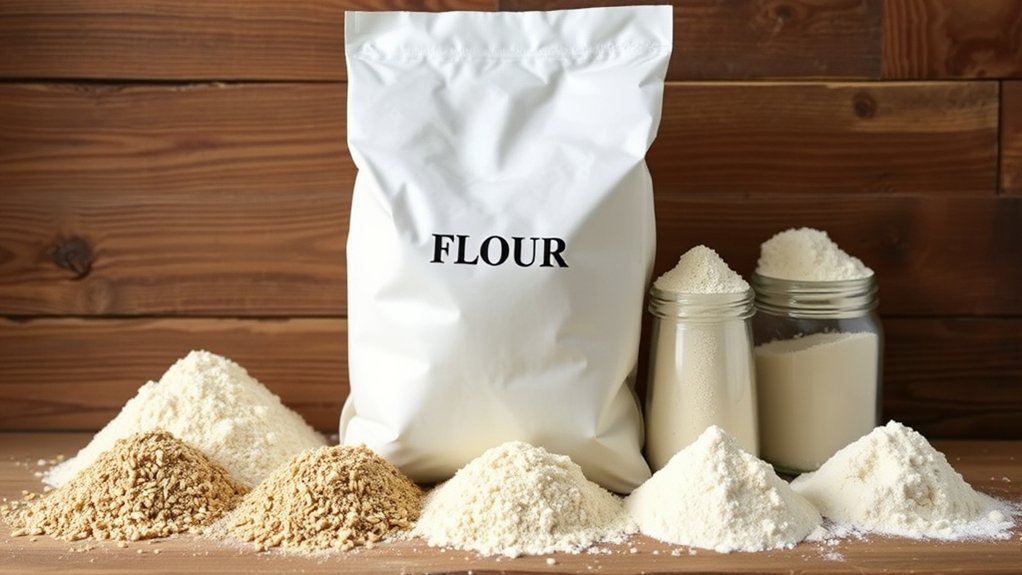
Two bags can both weigh 5 pounds, yet give you very different cup counts because each flour type packs and weighs differently.
You’re always working with the same 80 ounces, but density shifts how many cups you’ll scoop.
All-purpose flour typically gives you about 17–20 cups. Each cup weighs around 120–130 grams, so a standard 5 lb (about 2,270 grams) bag lands near 18–19 cups.
Bread flour is denser, about 130–135 grams per cup, so you’ll usually get only 16–18 cups. Its higher protein content makes it pack more tightly.
Cake flour sits at the opposite end. It’s finely milled and low in protein, so it’s lighter—around 100–110 grams per cup. That’s why you can get roughly 20 cups from the same 5 pounds.
Whole wheat flour, with bran and higher ash content, packs heavier again, netting about 15–17 cups from a 5 lb bag.
Weight Vs Volume: How to Measure a 5 Lb Bag of Flour
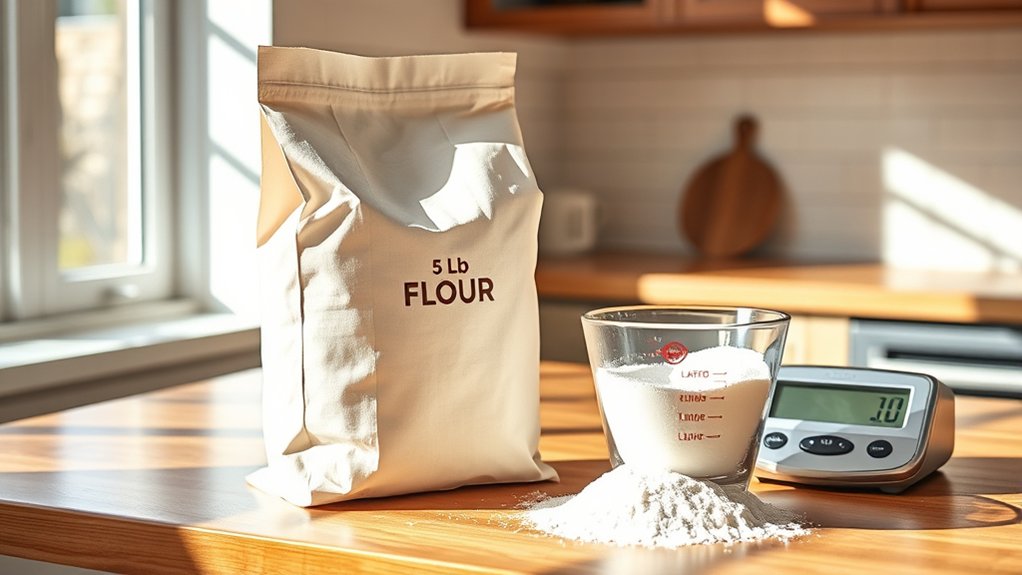
When you measure by volume, the same 5 lb can range from about 15–20 cups. Spoon-and-level, scoop-and-sweep, or sifting first can shift each cup by 10–20%, which adds up fast across a whole bag.
- Weight never varies: 1 lb of flour is always 453.6 grams.
- Volume does: sifted flour can expand by 10–15% before you scoop.
- Different types average 15–20 cups per 5 lb, depending on density.
- For consistent baking, use a kitchen scale and follow gram amounts.
Which Containers Actually Fit a 5 Lb Bag of Flour?
When you’re storing a full 5 lb bag of flour, you’ll want a container that holds at least 4.75–6 quarts so there’s room to breathe and scoop.
Options like a Cambro 6-Quart CamSquare, King Arthur 6-Quart Square Container, or a large glass canister are all sized to handle that amount comfortably.
You’ll also want a bit of extra headspace so you can scoop without sending a cloud of flour across your counter.
Ideal Container Capacity
Although bag sizes can be confusing, a 5 lb bag of all-purpose flour reliably needs a container that holds at least 4.4–6 quarts (about 18–20 cups, or 4.5–6 liters) to fit comfortably without compressing the flour.
Stay within this range and you’ll avoid flour packed too tightly, which can affect measuring accuracy and freshness.
Aim for a container that also handles real kitchen use: you’ll open it often, scoop directly from it, and need it to stay sealed between bakes.
Key capacity-focused considerations include:
- Volume labeled as 150–190 fl oz or 1–1.5 gallons
- Wide mouth, ideally 5 inches, so cups and scoops fit
- Airtight, repeatable seal that withstands frequent opening
- Shape that’s stackable yet liftable under 10 lbs when full
Examples Of Compatible Containers
Now that you know the capacity range to aim for, it helps to see real containers that actually fit a 5 lb bag of flour in everyday use.
A Cambro 6 Quart CamSquare is a restaurant staple: its square, 6‑quart body easily holds 5 pounds of flour with extra space and stores efficiently.
The King Arthur 6‑Quart Square Container also fits a full 5‑pound bag and adds volume markings plus stackable organization.
If you prefer glass on the counter, the West Elm Canyon Large Canister (4.75 quarts, 152 fl oz) holds 5 pounds snugly and seals tightly.
For pantry bins, a Stay Fresh Clear Plastic Container is shaped for a single 5‑pound bag.
Bulk buyers can divide 25 pounds into several gallon or half‑gallon glass jars.
Extra Room For Scooping
One thing matters almost as much as capacity: leaving enough room to scoop. A 5 lb bag of all-purpose flour averages about 18–19 cups, but you shouldn’t choose a container that tight. You need around 20–25% extra volume plus 2–3 inches of vertical headspace so your scoop can move without sending flour over the rim.
- A 6-quart container (24 cups) easily fits 5 lb flour with headroom.
- That 24-cup capacity clears the 18.8-cup volume and the 20–25% buffer.
- Denser flours, like whole wheat or bread flour, still benefit from this size.
- A dedicated 5 lb “flour keeper” works too, as long as it’s rated for 18–20 cups and leaves visible air space above unpacked flour.
Practical Tips to Measure, Store, and Track a 5 Lb Bag of Flour
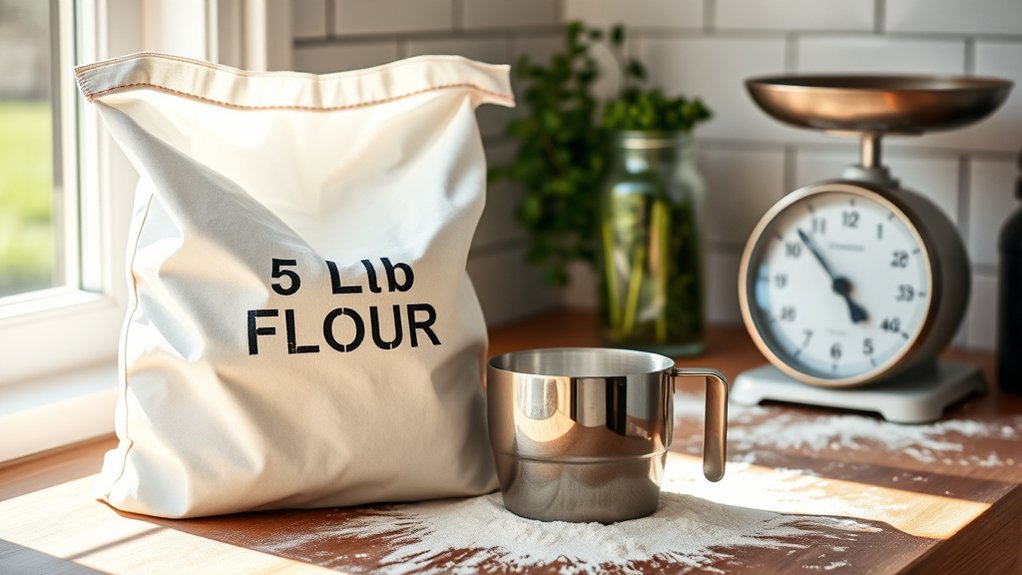
Two simple habits—measuring by weight and storing in the right container—make handling a 5 lb bag of flour much easier. Use a digital scale and remember that 5 pounds equals 80 ounces or about 2,270 grams.
Divide that by your flour’s grams per cup (about 120–130 g for all‑purpose) when you need an approximate cup count, but keep weighing for accuracy.
For storage, transfer the whole bag into a 6‑quart, food‑grade container (about 4.5–6 liters, or 1–1.5 gallons). That size comfortably fits the 18–20 cups a 5 lb bag can occupy, even with packing differences.
Choose an airtight, gasket‑sealed lid to keep moisture, odors, and pests out.
To track what’s left, use containers with volume markings or add your own labels. Note the fill line when new, then mark halfway and quarter points so you can quickly see when you’re down to your last pound or two.
Frequently Asked Questions
How Long Does a 5 Lb Bag of Flour Stay Fresh in Storage?
It stays fresh 6–12 months unopened, and about 3–6 months once opened at room temperature. You’ll extend freshness by sealing it airtight, keeping it cool and dry, or freezing it for a year or longer.
Can I Freeze a 5 Lb Bag of Flour to Extend Shelf Life?
Yes, you can freeze a 5 lb bag of flour to extend shelf life. Repack it into airtight, flattened bags, label and date them, freeze at 0°F, then thaw in the fridge and sift before use.
How Can I Tell if My 5 Lb Bag of Flour Has Gone Bad?
You check color, smell, texture, and bugs. If you see discoloration, mold, clumps, or insects, or smell rancid, sour, musty, or chemical odors, or taste bitterness or soapiness, it’s bad—discard it.
Does Sifting Change How Much Space a 5 Lb Bag of Flour Needs?
Yes, sifting makes the flour take up more space. You’ll aerate it, increasing volume by roughly 10–20%. Expect your 5 lb bag to need closer to 6 quarts instead of tighter 4–4.5 quart containers.
Is It Safe to Store a 5 Lb Bag of Flour in Its Original Packaging?
Yes, you can safely store it short term in its original bag, but you shouldn’t for long. After 6–12 months, oxidation, moisture, and pests become risks, so you should transfer it to an airtight container.
Conclusion
Now you know a 5 lb bag of flour isn’t just “a bag”—it has a predictable cup count, volume, and container size. Use weight for accuracy, volume for quick baking, and choose airtight containers that truly fit 5 lb. When you measure consistently and store flour well, your recipes turn out better and your pantry stays organized. Keep these numbers handy, and you’ll handle any 5 lb bag of flour with confidence.