Are Old Russian Banknotes Worth Anything? Collector Value Explained
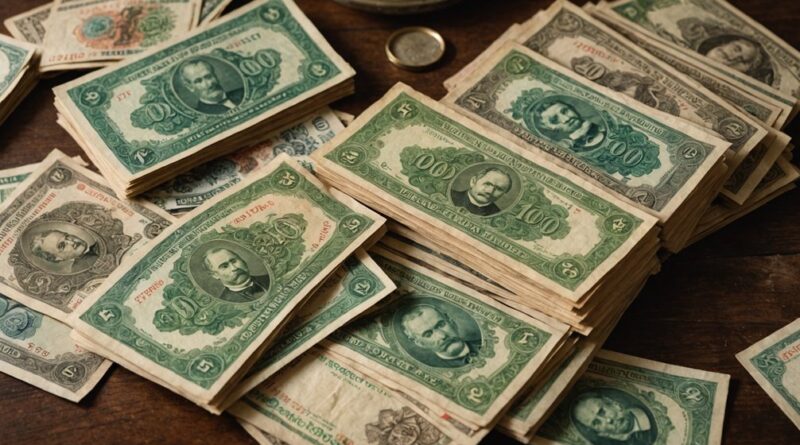
Old Russian banknotes can be worth anything from their face value to hundreds of dollars. You’ll see the biggest premiums on Imperial notes from the Tsarist era, scarce Soviet issues from the breakup and inflation years, and modern commemoratives like the Sochi 2014 or 2018 World Cup 100 rubles. Condition is critical—crisp uncirculated notes can bring 10–50 times more than worn ones. If you want to know which notes in your stash might be valuable, keep going.
Key Takeaways
- Many old Russian banknotes are worth more than face value, especially Imperial and early Soviet issues with low survival rates.
- Rarity, historical period, and artistic design strongly influence value; transitional high-denomination notes from 1993–1997 can be particularly desirable.
- Condition is critical: uncirculated notes often sell for 10–50 times more than similar circulated examples.
- Certain modern and commemorative notes, like the 1997 500 rubles or 2014/2018 100-ruble issues, already command strong premiums.
- To estimate value, compare notes using online price guides, auction results, and dealer listings, then consider professional grading for high-end pieces.
How Much Are Old Russian Banknotes Worth?
So how much are old Russian banknotes really worth today? You’ll see everything from a few dollars to substantial sums.
Common Soviet notes are cheap: you can buy a full set for about 250 rubles, roughly 4 US dollars, mainly for a photo album or display.
Moving into late Soviet and early post-Soviet issues, individual notes can do better. A 1991 50‑ruble note, which originally showed “50 rubles” in numbers and letters and circulated about seven years, might bring around 13–43 in today’s money, depending on how you value reported figures.
A 1993 high‑denomination note that was worth about 17 euros at issue can reach around 33 dollars now.
Modern Russian variants, especially the 1997 100‑ruble types, can sell higher at auction if they’re scarce varieties, with prices visible on marketplaces and Bank of Russia price references.
What Makes a Russian Banknote Valuable?
When you evaluate an old Russian banknote, you’re really weighing its historical period and rarity against its condition, design, and current market demand. A scarce Tsarist or early Soviet issue in crisp, graded shape with distinctive artwork will almost always command a premium. As more collectors pay attention to graded Russian banknotes, certified examples with high scores and PMG labels are becoming especially attractive for long‑term value.
Historical Period And Rarity
Although design and condition always matter, the real engine of value in old Russian banknotes is historical period and rarity. You’re not just collecting paper; you’re capturing brief, unstable moments in Russian history when money changed faster than the plates that printed it.
1. Imperial shocks and interregnums
Notes from the Tsarist era, especially pre‑1917 issues, gain value from low survival and political turmoil. The 1825 Constantine ruble prototypes, never widely minted, sit at the top of rarity. Among Imperial issues, the 1898 1 ruble credit notes with different signatures (Pleske, Timashev, Konshin, Shipov) show how specific varieties can carry distinct catalogue values even within the same design.
2. Soviet breakup and hyperinflation****
Short‑lived high denominations like the 10,000 rubles 1995 or scarce 1997 10 and 500 rubles owe their prices to rapid redenominations and withdrawals.
3. Limited commemorative runs
Specialized series—like the 2007 Sokol aviation set or 2017 2000 rubles—combine short print runs with strong historical themes.
Condition, Design, And Demand
Historical period and rarity set the stage, but condition, design, and market demand decide what you can actually get for a Russian banknote.
You’ll see sharp price jumps between grades: a VG+ 1898 1 ruble can hit $1000, while a lower F+ 1895 1 ruble brings about $700, and a tape‑repaired 1865 1 ruble sinks to roughly $200.
Extra features, like “94 GB” perforations on an 1898 5 ruble, can push an F‑grade note to around $400. Modern commemorative banknotes such as the Sochi 2014 and 2018 World Cup issues often carry premiums over face value because of their limited print runs and eye‑catching themes.
Design and appearance shape desirability. Tsarist coats of arms, Lenin portraits, and vivid Soviet colors all attract different buyers.
Modern notes add relief, microtext, and QR codes, but collector demand still favors higher denominations, better grades, scarce signatures, and bonds with more surviving coupons.
Imperial Russian Banknotes: Nicholas II and Earlier Values
Imperial Russian banknotes from Nicholas II’s reign and earlier combine ornate artwork with complex monetary history, so their value today depends on far more than age alone.
Imperial Russian banknotes blend lavish design with turbulent history, making value hinge on far more than age
You’ll see issues ranging from early State Credit Notes (from 1769) to Nicholas II notes of 1898–1917 with imperial eagles, portraits, and rich engravings. Wartime hyperinflation and low‑quality 1915 paper mean survivors—especially in high grade—are scarcer than you’d think.
To judge what yours might be worth, focus on:
- Series and denomination – Common 1, 3, 5, and 10 roubles are affordable, while 100 and 500 rouble notes (especially 1898 and 1909–1912 series) can bring thousands.
- Condition and grading – Uncirculated pieces certified by PMG or PCGS may realize 10–50× more than circulated notes; defects can slash value 70–90%.
- Rarity and market demand – Low print runs, Romanov links, rare varieties, and international bidding push top examples above $10,000.
Soviet Russian Banknotes: From Revolution to Lenin Designs
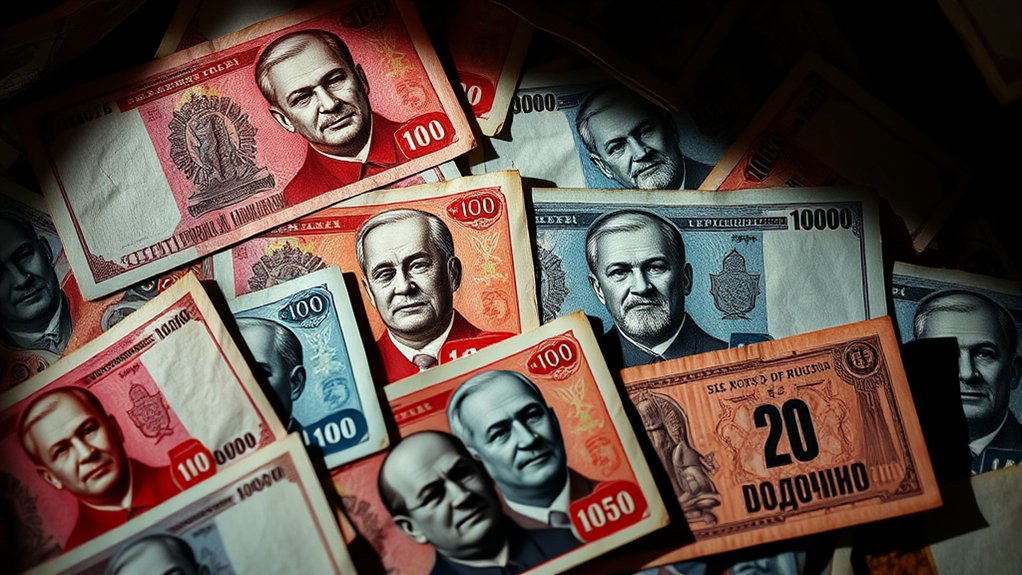
While Nicholas II’s ornate notes marked the twilight of Tsarist money, Soviet Russian banknotes show how a new regime used currency to broadcast ideology as much as value. When you pick up an early Soviet ruble, you’re holding the 1922 break with the imperial system, a unit still divided into 100 kopecks but now tied to a socialist experiment that lasted until 1991. Many early issues reflected the turbulence of the 1920s, when hyperinflation forced repeated redenominations and dramatic changes in note design.
Goznak’s Moscow and Leningrad facilities printed these notes with tight state control, using vivid greens, blues, and reds that now help you spot genuine pieces.
| Feature | What You’ll Notice |
|---|---|
| Portraits | Lenin’s profile on many key denominations |
| Symbols | Hammer and sickle replacing imperial emblems |
| Themes | Workers, farmers, and industrial scenes |
| Collecting Tip | Look for sharp colors and crisp details |
Because of strict central planning and non-convertibility, you see a gap between official values and real-world use, which now shapes collector interest.
Modern Russian Notes Worth More Than Face Value
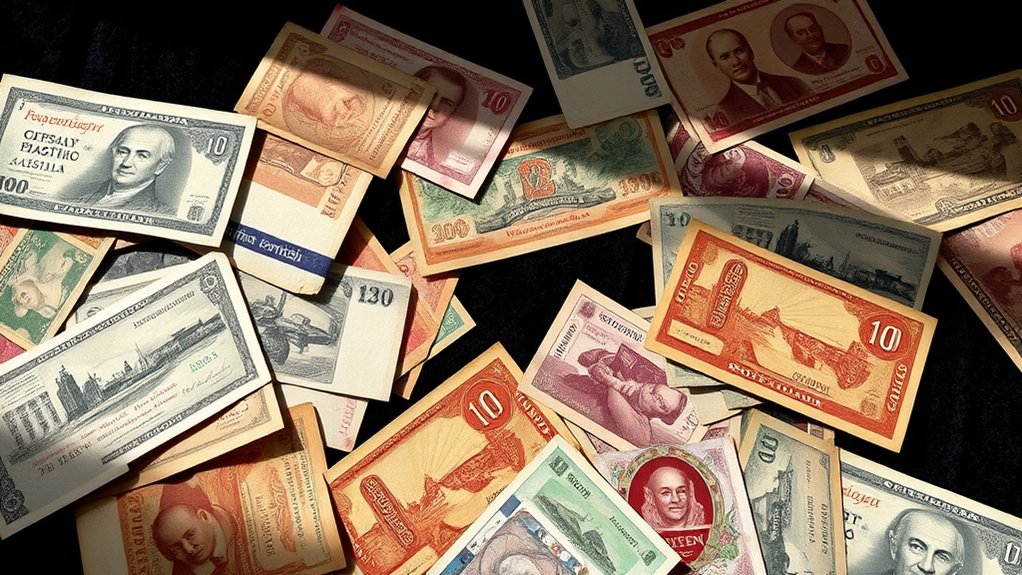
You might assume modern Russian rubles are only worth their face value, but some post-Soviet inflation survivors now command impressive premiums.
As you explore notes like the 1997 issues and later 200 and 2000 ruble designs, you’ll see how scarcity, condition, and demand turn everyday cash into collectibles. Recent design overhauls—including new denominations and updated security features—also create interest when older versions begin to be withdrawn from circulation.
You’ll also want to watch the market for scarce commemorative issues, where limited print runs and event links often push prices far beyond nominal value.
Post-Soviet Inflation Winners
Even in an era of rapid inflation and redenominations, several post-Soviet Russian banknotes have quietly turned into “inflation winners,” trading for far more than their printed face values.
Instead of eroding, their purchasing power actually grows once you step into the collector market.
Here are three standout categories you can target:
1. Transitional high denominations (1993–1997)
Notes like the 10,000 rubles 1995 with the Yenisei bridge, 1000 rubles 1995 Kremlin, and 1993 high values now sell for many times face, thanks to short circulation lives and architectural designs.
2. Iconic 500 rubles 1997
The explorer and caravel scene makes this a $90 note in top grade.
3. 2017 2000 rubles
Featuring Vladivostok’s Russky Bridge and Vostochny Cosmodrome, early 2017 issues can reach about $68 uncirculated.
Scarce Commemorative Issues
Although most modern Russian notes still trade close to face value, a handful of commemorative issues already punch far above their denomination thanks to bold designs and tight supply.
You’ll notice this first with the Sochi 2014 Olympic 100 rubles: its vivid artwork and first-time QR code push it firmly into collectible territory.
The 2018 FIFA World Cup 100 rubles follows the same pattern, mixing bright graphics, football imagery, and a scannable code that separates it from everyday monument notes.
Beyond sports, the 2007 Sokol aircraft factory series rewards set builders; all 18 aviation-themed notes together bring around 45 units.
Even the 1997 10 rubles with the Yenisei bridge can reach about 60 units, showing how specific regional scenes create modern scarcity.
Where to Check Prices and Sell Russian Banknotes
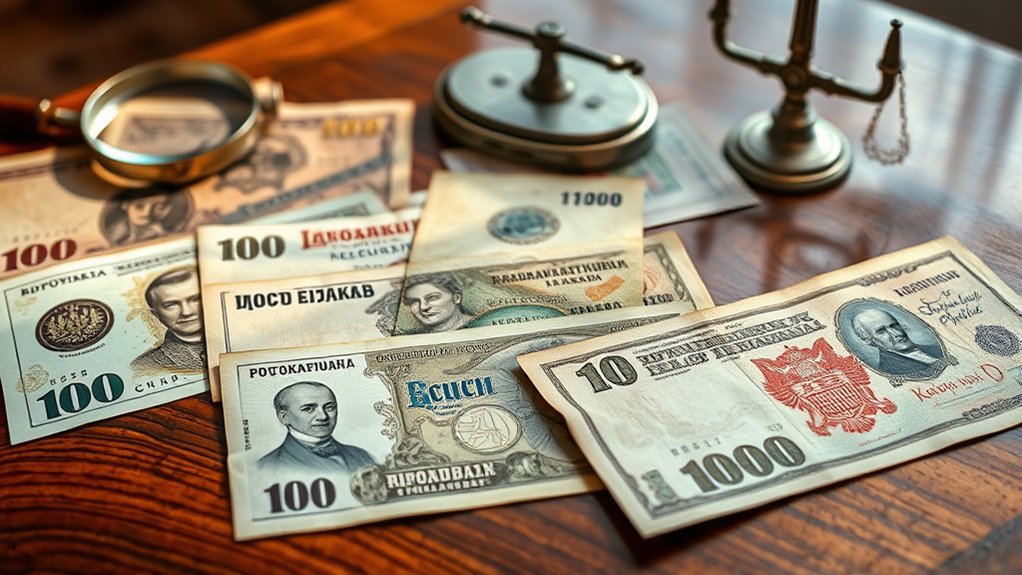
Several reliable tools and marketplaces make it straightforward to check prices and sell Russian banknotes, whether you’re dealing with rare Imperial issues or modern rubles.
Start with free online price guides, then compare with active dealer inventories and auction listings so you don’t underprice scarce notes or overestimate common ones.
1. Check baseline prices****
Use the PMG World Paper Money Price Guide and Greysheet. PMG lets you search by country, issuer, denomination, year, and Pick number; values are averaged estimates, not offers.
Greysheet refines this with grade‑specific data for Bank of Russia issues.
2. Compare with dealer listings
Review atsnotes.com, Numiscorner, Numismall, Banknoteworld, and Planetbanknote to see real asking prices across grades and eras.
3. Choose the right selling route****
List collectible notes through dealers like atsnotes.com or Numiscorner, while sending modern circulating rubles to Leftovercurrency.com for quick cash via bank transfer, PayPal, or cheque.
How to Store, Grade, and Spot Fake Russian Notes
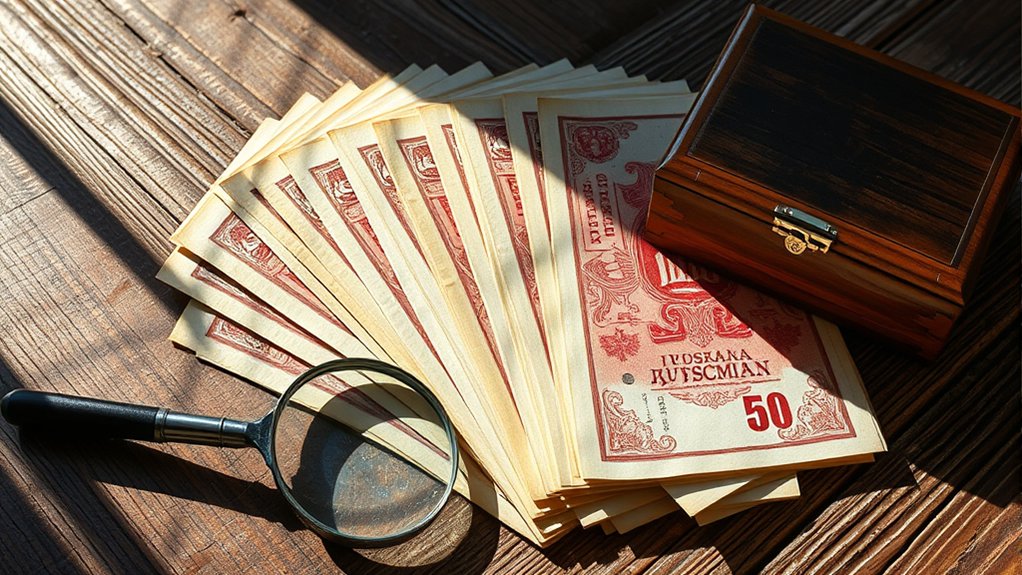
Once you know where to check prices and sell Russian banknotes, you need to keep them safe, understand their grade, and be confident they’re genuine.
Store each note in acid‑free Mylar (Melinex) or cellophane sleeves, or A4 archival pages, then place them in PAT‑passed, acid‑free boxes. Keep everything in a cool, dry room at roughly 18–22°C (64–72°F) and 45–55% humidity, away from attics, basements, radiators, and sunlight.
For slabbed notes, stand holders upright or lay them flat in lined boxes. Handle notes as little as possible and only by the edges. Don’t use PVC sleeves, regular envelopes, or cardboard, which cause yellowing and brittleness.
To spot fakes, check watermarks, security threads, and microprinting under magnification, and compare paper texture and UV reaction with trusted examples.
Verify designs, serial numbers, and emblems against catalogs, and use professional grading services for high‑value Imperial or early Soviet issues.
Frequently Asked Questions
Can I Legally Take Old Russian Banknotes Out of Russia?
You can, but you must follow strict export rules. Declare amounts over $10,000, get permits for pre‑1917 or numismatic notes, use expert appraisal, and never bypass customs, or you’ll face confiscation, heavy fines, or prosecution.
Do Sanctions or Politics Affect Russian Banknote Collectability Abroad?
Yes, they do. You’ll see reduced demand in some markets, stricter bank and dealer policies, payment and shipping hurdles, and possible export/import limits, though niche collectors may treat sanctions-era material as historically interesting.
How Should I Insure a Valuable Russian Banknote Collection?
You should insure it by getting professional grading, documenting notes with photos and serials, appraising via recent auctions, then buying a specialist collectibles policy with agreed-value coverage, worldwide transit protection, and climate-controlled storage requirements, reviewing limits regularly.
Are Error or Misprinted Russian Banknotes More Collectible Than Regular Issues?
Yes, you’ll usually find Russian error or misprinted notes more collectible than regular issues, especially in high grades. You should focus on dramatic, well-documented errors, since specialists often pay several times standard catalog value.
What Beginner Mistakes Lower the Value of Russian Banknotes Most?
You hurt value most when you expose notes to moisture, sunlight, or high humidity, cause folds, tears, or writing, attempt cleaning with water or chemicals, and handle them with bare, oily fingers or improper sleeves.
Conclusion
You’ve got a good chance of finding value in old Russian banknotes if you know what to look for. Focus on rarity, historical period, condition, and special features like signatures or errors. Always compare your notes to trusted catalogs, auction results, and reputable dealers before selling. Store them properly, learn basic grading, and watch out for fakes. With a bit of research, you’ll quickly tell what’s just pocket change—and what’s a real collectible.