Why Does a Ramp Make Work Easier? The Science Explained
You use a ramp to make work easier because it lets you apply a smaller force over a longer distance to lift the same load to the same height. In physics, the total work against gravity stays about the same, but a ramp trades force for distance, giving you “mechanical advantage.” A gentler, longer ramp means less pushing force, though friction steals some of the benefit. You’ll see how angle, friction, and design all affect how easy a ramp feels.
Key Takeaways
- A ramp doesn’t reduce the total work done; it spreads the required effort over a longer distance, making the task feel easier.
- By trading distance for force, a ramp provides mechanical advantage: a longer ramp requires less force to lift the same load to the same height.
- Ideal Mechanical Advantage equals ramp length divided by height, showing how much the ramp can theoretically reduce the needed force.
- Friction reduces real-world advantage, so smoother, well-maintained ramp surfaces require less extra force and keep effort closer to the ideal.
- Gentle slopes and low-friction materials make ramps especially effective for wheeled loads like wheelchairs and carts, allowing users to apply manageable forces.
What It Really Means When a Ramp “Makes Work Easier

When you say a ramp “makes work easier,” you’re not saying it reduces the total amount of work that has to be done—you’re really saying it lets you spread that same work out in a more manageable way.
In physics, you do work whenever you apply a force to an object and it moves in the direction of that force. A ramp is one type of simple machine called an inclined plane, which lets you trade a smaller force for a longer distance to get the job done.
A ramp doesn’t magically lower the amount of work required to raise a load; gravity still demands the same energy to lift something a given vertical distance.
What changes is how you supply that work. Instead of lifting straight up with a large force over a short distance, you push along the ramp with a smaller force over a longer distance.
The ramp simply redirects and redistributes the effort, letting you choose a force level you can actually handle while still accomplishing the same overall task.
How Ramps Use Mechanical Advantage to Cut the Force You Need
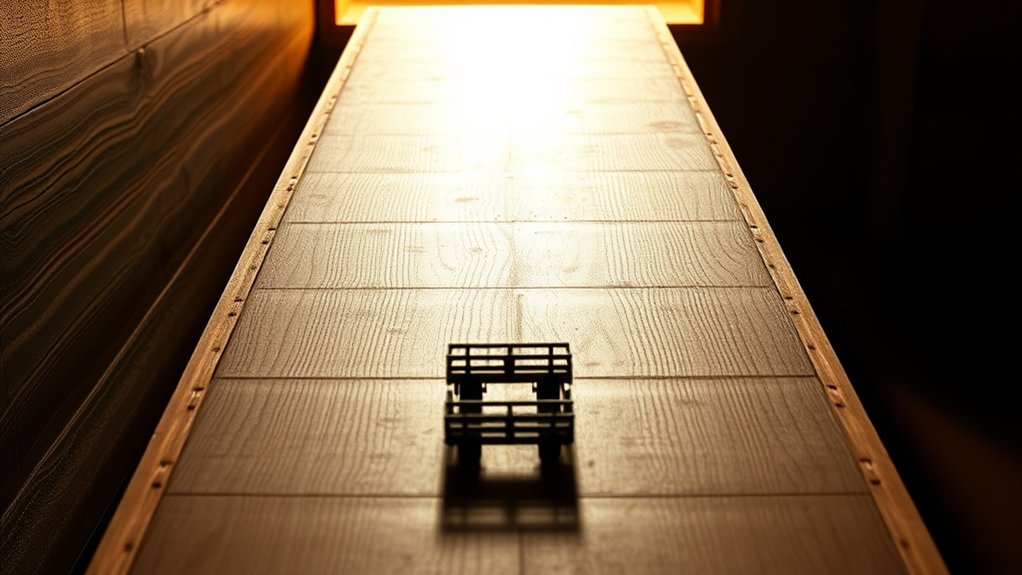
When you use a ramp, you’re really trading force for distance: you push over a longer path so you don’t have to push as hard. Mechanical advantage measures this trade, telling you how much the ramp cuts the force you need compared with lifting straight up. To understand how ramps truly help you, you’ve got to compare the ideal mechanical advantage (ignoring friction) with the actual advantage you get in real life. In both cases, the total work done stays the same, because the force and distance always multiply to the same value.
Trading Force For Distance
Slide a box up a ramp and you’re literally trading force for distance: you push with less force, but over a longer path. That’s mechanical advantage in action.
The ramp’s advantage equals its length divided by its height—effort distance over load distance. Because of this, the IMA is always greater than 1 for a ramp that actually rises.
If a ramp is 6 meters long and rises 3 meters, its mechanical advantage is 2. You only need about half the force you’d use to lift straight up, but you move the box twice as far.
Make the ramp longer and gentler, and you increase that ratio.
A ramp with mechanical advantage 5 cuts the needed force to one‑fifth, but you travel five times the height. You’re spreading the same work over more distance, so each push feels easier.
Ideal vs Actual Advantage
Even though a ramp can feel like it magically makes heavy loads lighter, there’s a clear difference between its “on-paper” help and what you actually feel. The “on-paper” version is the Ideal Mechanical Advantage (IMA). You find it by dividing the ramp’s length by its height. A 5 m ramp lifting 0.75 m has an IMA of about 6.7, meaning, in theory, you’d need roughly 1/6.7 of the lifting force. This is similar to how the IMA of ramp is calculated in physics, where the distance you move compares to how high you lift the load.
In real life, friction cuts into that benefit. The Actual Mechanical Advantage (AMA) is always smaller because some of your effort fights friction. An IMA of 2 might turn into an AMA of about 1.5.
Wheels help you get closer to the ideal, but you’ll never reach it perfectly.
Why Total Work Stays the Same With or Without a Ramp

Although a ramp clearly makes a job feel easier, the total work you do to raise an object to a certain height doesn’t change. In physics, work equals the force parallel to the motion times the distance moved. Work is measured in Joules, the same unit as energy, which highlights that doing work transfers or changes an object’s energy state.] When you push a box up a frictionless ramp, you apply a smaller force, but over a longer path.
When you lift it straight up, you use a larger force over a shorter distance. Either way, you’re increasing the box’s gravitational potential energy by the same amount, so the total work stays equal.
- You trade high force/short distance for low force/long distance.
- A ramp that halves the needed force doubles the distance, keeping work constant.
- Work against gravity depends only on height gained, not the path.
- The normal force from the ramp does no work; it’s perpendicular to motion.
- With real friction, you do slightly more work, but the ideal comparison still holds.
How Ramp Steepness Changes How Hard You Have to Push
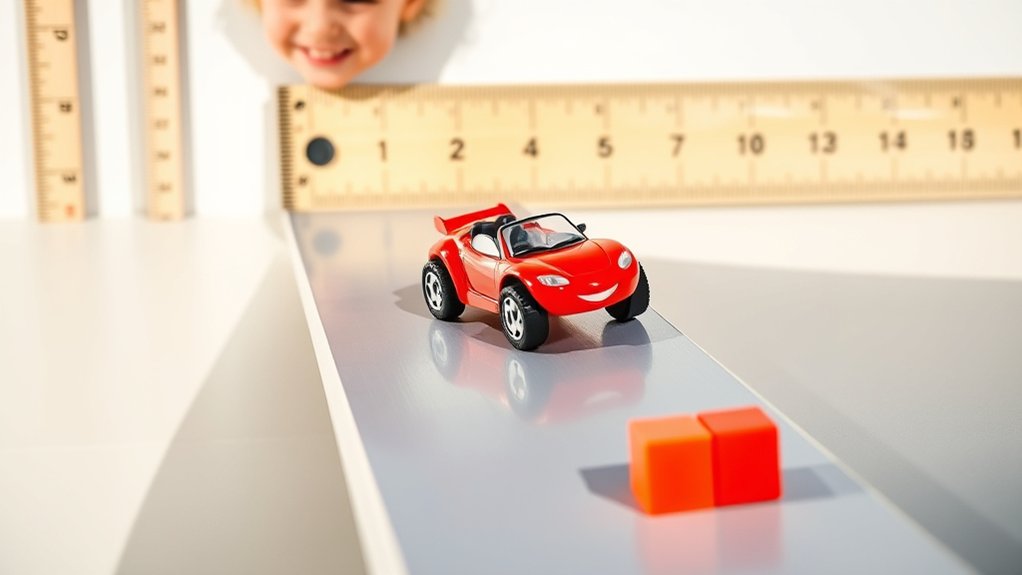
When you change how steep a ramp is, you’re really changing how much force you have to apply at any moment to move something up it. A gentler slope means you push with less force, because the ramp’s mechanical advantage increases as its angle to the ground decreases.
You spread the same total work over a longer distance, so each push feels easier. You can see this in the ideal mechanical advantage (IMA) equation:
IMA = length of ramp ÷ height of ramp
If you keep the height the same and make the ramp longer, IMA goes up and your required force goes down by that factor. An IMA of 5 means you only need one-fifth the force of lifting straight up.
A steep ramp does the opposite: it shortens the distance, slashes IMA, and pushes you closer to the full lifting force.
How Friction Changes a Ramp’s Real-World Mechanical Advantage

When you add friction to a ramp, the mechanical advantage you calculated on paper instantly drops because some of your input force now just fights rubbing between surfaces.
You’ll always push harder in real life than the ideal numbers suggest, but you can recover much of that “lost” advantage by reducing friction wherever the object, rope, or hardware contacts the ramp.
Next, you’ll see how friction cuts into your ramp’s performance and what simple changes help you keep the advantage as high as possible.
Why Friction Reduces Advantage
Even if a ramp seems like it should always make lifting easier, friction quietly cuts into its real-world advantage. On a ramp, friction always pushes opposite the motion, so you must push harder than ideal calculations suggest. In theory, you’d ignore friction and get an “ideal mechanical advantage,” but you’ll never reach that outside a textbook.
In real systems, friction depends on surface materials, angle, and contact points like pulleys or rope bends. Each adds resistance and shrinks the actual mechanical advantage, often by 20–40%.
- Friction force = μ × N, adding to the force you must apply
- Rougher ramp surfaces increase energy loss
- Wet, icy, or dirty conditions change friction and efficiency
- Rope rubbing on edges or padding adds drag
- Multiple contact points compound total friction
Minimizing Frictional Losses
Although friction always robs a ramp of some of its theoretical benefit, you can deliberately design and maintain the setup to keep those losses small.
You start by reducing the friction coefficient μ: add grease or oil, or choose low‑friction coatings like Teflon so μ·N, the friction force, drops and your input force falls closer to the ideal.
Next, pick smart materials and geometry. Smooth metal or polished surfaces beat wood or rubber. A longer, gentler ramp angle lowers the normal force component that feeds friction, boosting real mechanical advantage.
Finally, rethink contact. Use rollers, wheels, or ball bearings to swap sliding friction for much smaller rolling friction, and keep the ramp clean, dry, cool, and well‑maintained.
Everyday Ramp Examples: Wheelchairs, Trucks, and Curbs

From sidewalks to loading docks, ramps quietly turn hard lifting jobs into manageable pushes and rolls. When you watch someone use a wheelchair ramp, you’re seeing mechanical advantage in action. Instead of lifting straight up like a stair, the ramp lets a user apply a smaller force over a longer distance, so getting into a building or across a curb cut takes less effort and more control. The same physics helps delivery workers every day.
When you roll a 100‑pound load up an 8‑foot truck ramp, you might only push with about 25 pounds of force. A longer, gentler ramp makes the job easier, even though you walk farther.
- Notice curb ramps at intersections and how they guide wheels smoothly.
- Watch trucks using ramps at loading docks.
- Try pushing a cart up a ramp versus a step.
- Compare steep versus gentle ramps.
- Look for ramps in parking garages and malls.
Conclusion
When you use a ramp, you’re not doing less total work—you’re just spreading that work out over a longer distance so it feels easier. By lowering the force you need, a ramp gives you mechanical advantage, especially when it’s not too steep and friction’s under control. Whether you’re pushing a wheelchair, loading a truck, or rolling over a curb, you’re using simple physics to work smarter, not harder.