What Happened to the Terrorists at Entebbe? The Full Story
At Entebbe, you’re following four original hijackers—two PFLP Palestinians and two German radicals—backed and armed by Idi Amin’s Ugandan regime. They hijack Air France Flight 139, separate Israelis and Jews, and hold 106 hostages in a fortified terminal. When Israeli commandos storm the airport on July 4, 1976, they kill all the hijackers in minutes, rescue most hostages, and leave no credible trace of surviving terrorists, but the full story runs much deeper.
Key Takeaways
- All four original hijackers on Air France Flight 139 were killed by Israeli commandos inside the Entebbe airport terminal during the July 4, 1976 raid.
- Three additional PFLP operatives assisting the hijackers were also killed in the assault, bringing the total number of dead terrorists to seven.
- The remaining three hijackers disappeared in the chaos after the raid, with no credible evidence they survived or were ever active again.
- Ugandan forces, who had armed and supported the hijackers, were engaged by Israeli commandos, further dismantling the terrorists’ protective environment.
- None of the Entebbe hijackers escaped justice; those not confirmed killed effectively vanished from history without verifiable trace or later public appearance.
Entebbe Hijacking Overview: Who Were the Terrorists and What Did They Want?
Although the hijacking unfolded over just a few days in June 1976, the group that seized Air France Flight 139 represented years of radicalization and international militant cooperation.
You’re dealing with four original hijackers: two Palestinian militants from Wadie Haddad’s PFLP–External Operations, Jayel al‑Arja and Fayez Abdul‑Rahim al Jaber, and two German extremists from Revolutionary Cells, Wilfried Böse and Brigitte Kuhlmann. They commandeered the Airbus A300 after its Athens stopover, with 248 passengers aboard, then forced it to Benghazi for refueling before flying to Entebbe. The Israeli rescue force ultimately flew about 2,500 miles from Israel to Entebbe to reach the hostages.]
On the ground, six additional PFLP operatives joined, bringing the total to ten.
You see their strategy in how they sort hostages: they check passports and appearances, eventually releasing 144 non‑Israeli, non‑Jewish passengers while retaining about 106 people—mostly Israelis and Jews plus the loyal Air France crew.
Their goal’s explicit: leverage those lives to free 53 imprisoned militants across several countries.
How Ugandan Support Enabled the Entebbe Hijackers
As you move from the hijackers’ identities and demands to their operational reality on the ground, you need to see how Idi Amin’s personal backing turned Entebbe into far more than a distant African stopover.
You’re not just looking at a dictator’s theatrics but at a head of state who welcomed the gunmen, armed them, and let them use his airport as a fortified staging area. Amin’s forces supplied automatic rifles, explosives, and tight perimeter security, effectively transforming the Old Terminal into a state-supported hostage prison.
Once you factor in Ugandan military collaboration around the Old Terminal, you’re dealing with a hostage crisis supported by national forces, not just a rogue terrorist cell.
Idi Amin’s Direct Backing
When the hijacked Air France Flight 139 landed at Entebbe, Idi Amin didn’t just tolerate the terrorists’ presence—he legitimized it. You see him greeting hijackers and hostages with theatrical warmth, turning a criminal act into a state‑sanctioned spectacle. His frustration with Israel over failed financial arrangements and cooling ties primed him to embrace the crisis as political leverage.
You also watch Amin recast himself as a champion of the Palestinian cause. Criticized by Arab leaders like Gaddafi for past cooperation with “Zionist” Israel, he seizes the hijacking to pivot toward Arab allies and assert independence from Western influence.
Ugandan Military Collaboration
Instead of treating the hijacking as a foreign criminal crisis on Ugandan soil, Amin’s regime folded its own military directly into the operation and turned Entebbe into an armed sanctuary for the terrorists. You see over 100 Ugandan soldiers reinforcing the Old Terminal, guarding hijackers rather than containing them, while Amin personally welcomes the militants and keeps his forces aligned with their demands. This collaboration meant that Israeli commandos had to fly more than 4,000 kilometers to launch a long-range rescue mission directly into hostile, state-controlled territory.
| Aspect | Ugandan Military Role |
|---|---|
| Perimeter & Security | Presidential Guard units fortify the terminal and act as auxiliary gunmen. |
| Weapons & Logistics | Uganda supplies and replenishes automatic rifles, explosives, and extra militants. |
| Airfield Control | Eleven MiG jets, the runway, and ATC remain under Ugandan command. |
| Strategic Impact | Israel must treat Entebbe as a state-backed fortress, destroying all 11 MiGs during the raid. |
How the Hijackers Managed and Selected Hostages at Entebbe
Although the Air France hijacking began in the cabin at 30,000 feet, the terrorists’ real system of control took shape only after the plane reached Entebbe, where they turned the old terminal into a sorting ground for human lives. You’d see them expand from the original four hijackers to roughly a dozen, backed by over 100 Ugandan soldiers, then reorganize everyone into tightly watched rooms. They worked through passports and interrogations, pulling out Israelis and anyone Jewish. At least 10 non-Israeli Jews were pushed into the group of 84 Israelis, while some dual nationals tried to pass under other identities. Ugandan ruler Idi Amin openly cooperated with the terrorists, even visiting the hostages and presenting himself as a mediator while facilitating their demands. One Israeli officer even slipped through with a non-Israeli passport.
At Entebbe’s old terminal, the hijackers transformed arrival into a ruthless sorting ground for human lives
Their power rested on proximity and fear: guns always visible, threats constant, movement restricted.
- Physical separation of groups
- Document checks and personal questioning
- Continuous intimidation with weapons and shouted orders
Inside Operation Entebbe: What Happened to the Hijackers During the Raid?
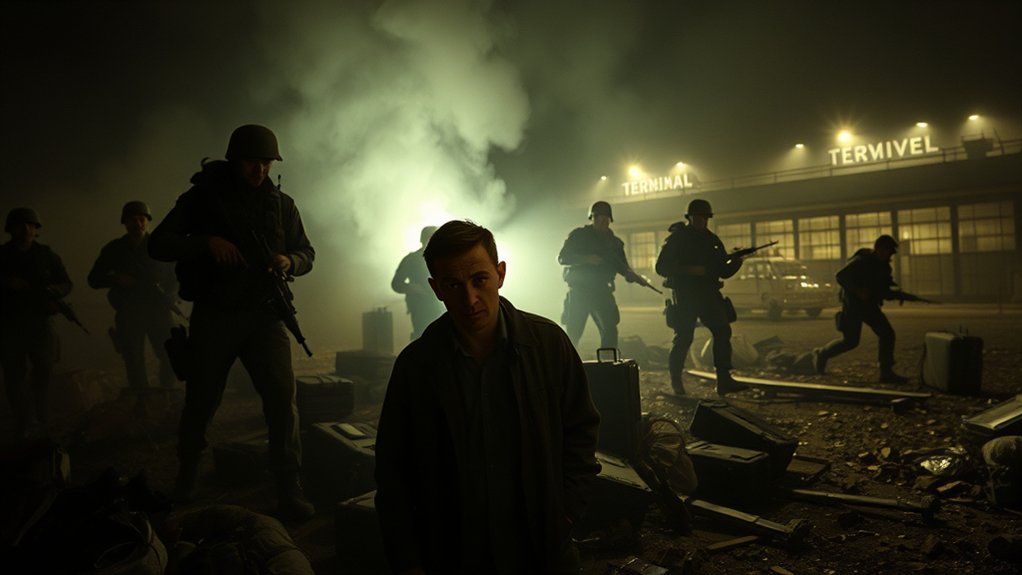
As you move into the raid itself, you see how Israeli commandos launched a lightning assault that overwhelmed the hijackers in barely more than a minute inside the terminal.
You’ll track what happened to each of the PFLP-linked operatives and their German allies as the teams cleared the main hall and side rooms. During the same operation, Israeli commandos also destroyed several Ugandan air force planes on the ground to prevent pursuit and further threats.
You then examine the casualties and final tally—who was killed, who survived, and how the operation’s outcome was ultimately measured.
Lightning Assault On Hijackers
The assault on the hijackers at Entebbe unfolded in a matter of minutes, a sudden, violent breach that left no room for negotiation or escape. You’d see the first C-130 land, commandos racing out in a black Mercedes meant to mimic Idi Amin’s.
When Ugandan guards noticed discrepancies, gunfire erupted, but the Israelis pushed through to the defunct terminal.
Inside, they burst into the main hall, killing three hijackers instantly. Hostages pointed out more gunmen in a side room; commandos hurled grenades, then stormed in and shot them.
Wilfried Böse, who’d told hostages to shelter, fired only at soldiers before he fell.
- You witness a feint with Amin-style vehicles
- You see a terminal stormed in seconds
- You grasp that no hijacker survives
Fate Of PFLP Operatives
That sudden burst of gunfire and grenades didn’t just free the hostages; it wiped out nearly all of the PFLP team that had engineered the hijacking.
You watch the operation’s core unravel in minutes: the four original hijackers—Palestinians Jayel al‑Arja and Fayez Abdul‑Rahim al Jaber, and Germans Wilfried Bose and Brigitte Kuhlmann—are all killed inside the terminal.
You also see three of the six additional PFLP operatives, who’d waited on the ground in Entebbe, fall under the commandos’ fire.
Seven of the ten hijackers die where they’d believed Ugandan protection made them untouchable. The remaining three vanish into the confusion after Ugandan support collapses; no credible record of their survival or later activities surfaces, leaving their ultimate fate unresolved.
Casualties And Final Tally
While the gunfire and explosions at Entebbe felt chaotic, the final toll on everyone involved was brutally clear. You can track the outcome in four groups: hijackers, PFLP reinforcements, hostages, and Israeli commandos.
All four hijackers from the plane died in the raid, along with three of the six PFLP operatives who’d joined them on the ground, leaving seven terrorists confirmed dead out of ten.
You also see the human cost among hostages: three died in the terminal, ten were wounded, and 102 made it out.
Dora Bloch survived the raid only to be murdered later in Kampala under Ugandan orders. Israel lost one man, Yonatan Netanyahu, and had five commandos wounded.
- Hijackers and PFLP fighters
- Hostages
- Israeli forces and Ugandan role
The Final Fate of the Entebbe Hijackers: Deaths, Captures, and Escapes
Although the hijacking of Air France Flight 139 began with a small four-person team, none of the Entebbe terrorists survived the crisis they created. You’re looking at a case where every original hijacker and each ground accomplice died in the same operation that freed the hostages.
None of the Entebbe hijackers survived; every terrorist died in the same operation that freed the hostages
The two Palestinian PFLP operatives, Jayel al‑Arja and Fayez Abdul‑Rahim al Jaber, and the two German radicals, Wilfried Böse and Brigitte Kuhlmann, all fell to Israeli fire inside the old terminal on July 4, 1976. They’d diverted the jet through Benghazi to Entebbe and demanded the release of 53 militants; they didn’t leave Uganda alive.
At Entebbe, four more terrorists joined them, bringing the total to seven or eight. Israeli commandos killed every one during the assault, alongside dozens of Ugandan soldiers.
No hijacker was captured, and none escaped. After the raid, no surviving militant remained to hunt, trade, or interrogate.
How the Entebbe Hijacking Changed Counter-Terrorism and Airline Hijacking Tactics
Every hijacker at Entebbe died in the same burst of gunfire that freed the hostages, but the real shockwave from the raid spread far beyond Uganda.
Before 1976, you watched hijackers dictate terms while governments stalled and improvised. The September 1970 Jordanian crisis had already shown how easily terrorists could seize planes, grab headlines, and push states toward war.
Entebbe flipped that script. You now had proof that a government could fly special forces thousands of miles, strike within minutes, and walk out with nearly every hostage alive.
That success pushed states to build permanent, elite units and rethink how to handle hijacked aircraft.
- You saw negotiation paired with a credible, ready assault option.
- You saw airport security harden, making hijackings riskier and rarer.
- You saw terrorists abandon mass airline seizures, narrow demands, and grow more cautious.
Frequently Asked Questions
Did Any Entebbe Hijackers Face Trial or Legal Proceedings After the Raid?
You don’t find evidence that any Entebbe hijackers faced trial. Israeli commandos killed seven during the raid, and Uganda protected or let others disappear, violating Hague obligations and effectively preventing subsequent criminal proceedings against surviving perpetrators.
How Did Families of the Entebbe Terrorists React to Their Deaths?
You don’t find documented reactions from the terrorists’ families; historical records don’t preserve grief, statements, or protests. Sources focus on the raid, PFLP and Revolutionary Cells roles, and hostage rescue, leaving kin responses unknown or unreported.
What Happened to the Entebbe Hijackers’ Support Networks in Europe and the Middle East?
You can’t trace a single fate: some Revolutionary Cells and PFLP-EO members kept operating, others got arrested, splintered, or faded; state backers like Libya and Amin’s Uganda shifted tactics under pressure, but didn’t fully abandon militancy.
Were There Ideological Splits Within the Terrorist Groups After the Entebbe Failure?
You don’t see clear ideological splits documented after Entebbe; instead, you see tactical recalculations. Baader-Meinhof’s decline accelerates, while the PFLP adapts methods under pressure, but both keep core Marxist‑revolutionary goals rather than fracturing openly.
How Have the Entebbe Terrorists Been Portrayed in Films, Books, and Media Since?
They’ve appeared to you as fanatical villains, conflicted ideologues, or tragic revolutionaries. You see Germans Böse and Kuhlmann spotlighted, Palestinians briefly sketched, Ugandan backing stressed, and narratives consistently ending with their deaths validating the raid’s success.
Conclusion
When you look back at Entebbe, you see more than a daring rescue. You see how determined governments can disrupt terror, even when hijackers seem untouchable. The gunmen didn’t just lose their hostages; they lost their power, their leverage, and, for most, their lives. You’re left with a clear lesson: planning, surprise, and resolve can flip the script on terrorism—and change how the world responds to hostage crises.