
How Much Did It Cost to Build the IDS Center in Minneapolis?
You won’t find a single official price tag for building the IDS Center in Minneapolis because it was privately financed and detailed 1970s cost records weren’t made public. However, based on its 1.4 million square feet, construction era, and comparable skyscrapers, you’re realistically looking at about $125 million in early‑1970s dollars, or roughly $90 per square foot. Later sale prices reflect market value, not build cost, and there’s more behind how that estimate comes together.
Key Takeaways
- No definitive public record states the exact original construction cost of the IDS Center; many 1970s financial details remain private or scattered.
- A well-supported historical estimate places the original construction cost at roughly $125 million in early-1970s dollars for the full complex.
- This estimated cost covers the IDS Tower, Crystal Court, and related mixed-use components as a single integrated development.
- Based on about 1.4 million square feet, the project’s construction cost is estimated at approximately $90 per square foot in early-1970s dollars.
- Later sale prices (e.g., $253 million in 2013, $277 million in 2022) reflect market value and do not represent original construction costs.
What We Know About IDS Center Construction Costs
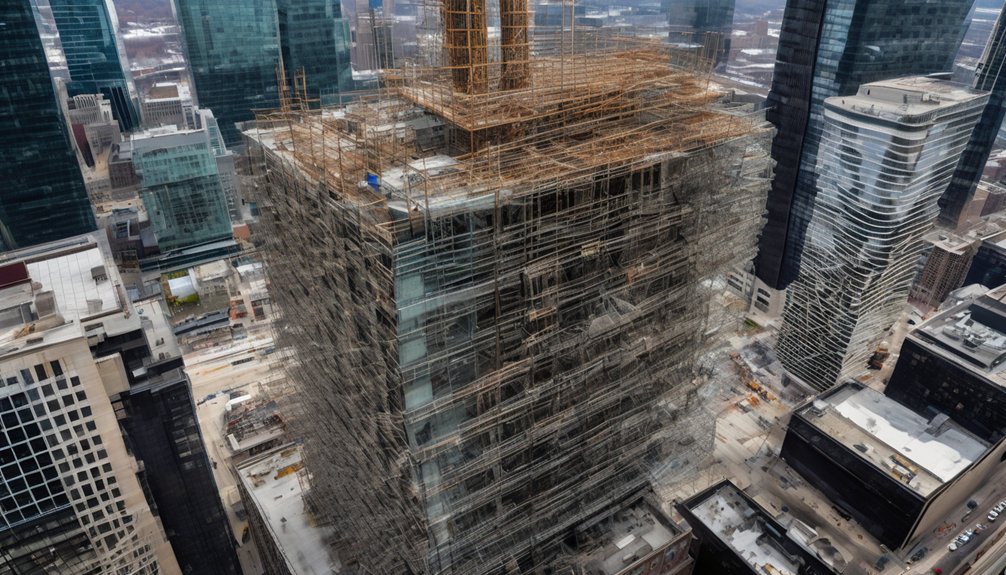
While there’s plenty of public information about what the IDS Center has sold for and what it’s cost to renovate, hard data on its original 1970s construction budget is surprisingly elusive.
When you search, you quickly find numbers tied to recent deals: a $253 million sale in 2013 and a later transaction around $277 million. Those recent sale prices also came after a prior change in ownership in 2004, when the tower sold for about $224.5 million.]
You also see discrete project figures, like the roughly $5 million Crystal Court upgrade.
Those numbers tell you what the tower’s worth to contemporary investors and what owners have spent on selective improvements, but they don’t reveal how much it actually cost to build.
They hint at value and upgrades, not the original, all‑in price of creating the tower
You’re not seeing line items for steel, curtain wall, labor, financing, or land acquisition from the development years.
Instead, you’re working with a patchwork: modern sale prices and renovation budgets from secondary sources, without primary evidence of the full, original construction cost locked into a single, authoritative figure.
Why IDS Center’s True Build Cost Is So Hard to Find
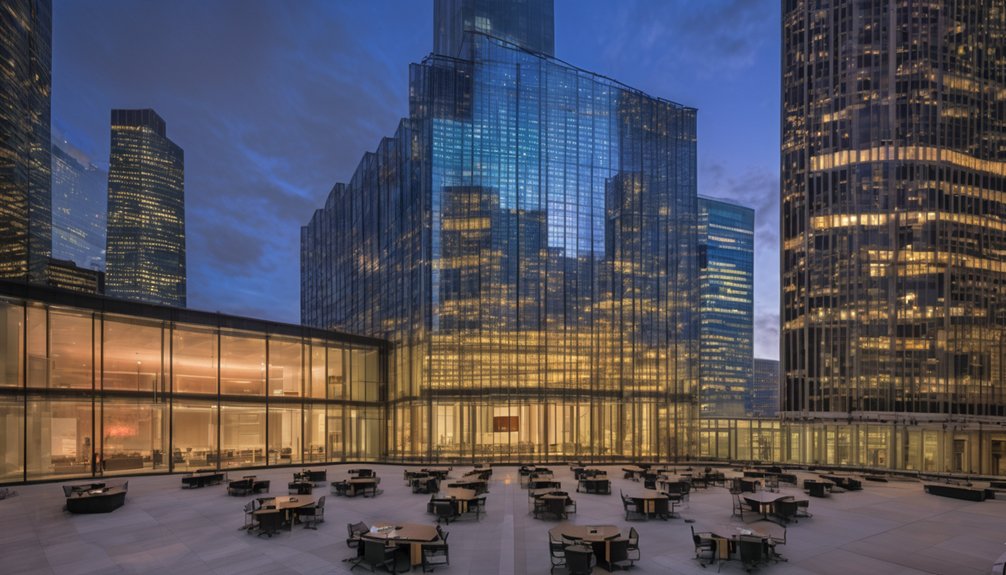
You’re not struggling to find IDS Center’s real construction cost because you’re looking in the wrong place; you’re struggling because the records themselves are fragmented and incomplete.
Key documents from the early 1970s sit in scattered archives, if they’re preserved at all, rather than in a single public file.
On top of that, private development financing meant the original investors had little incentive to publish a transparent, line‑by‑line account of what the tower actually cost to build. The difficulty is compounded by later transactions, such as its 2013 sale to Beacon Investment Properties for $253 million, which reflect market conditions and investment cycles rather than the tower’s original construction budget.
Fragmented Historical Records
Although the IDS Center dominates Minneapolis’s skyline, piecing together what it actually cost to build is surprisingly difficult because the public record fixates on everything but the original price tag.
When you dig into documents, you mainly find sale figures: $253 million in 2013, about 9 percent more in 2006, and $277 million in 2022, plus a county assessment around $193 million. None of these mention what it cost to construct.
Instead, the record spotlights renovations and design changes. You see the $5 million Crystal Court overhaul in 2021 detailed down to benches, trees, and an infinity pool, yet nothing on 1970s construction.
Early 1960s plans note 12 stories swelling to 57, square footage, and ownership shifts—but no unified, original build figure.
Private Development Financing
One core reason the IDS Center’s true construction cost is so elusive is that it was always a privately financed deal, structured to satisfy lenders and investors rather than future historians.
You see only fragments: a 1973 completion figure of $13.5 million with no breakdown of loans, equity, or guarantees.
Later sale prices—$200 million in 1981, $225 million in 2004, $277 million afterward—reflect shifting market value for a 1.4‑million‑square‑foot mixed-use asset, not what it cost to build. The building’s recent 12‑month loan extension further underscores how financing details we do see are tied to current performance rather than original construction outlays.
Current financing, like the $151.66 million mortgage and its extensions, tells you about today’s debt, not 1970s construction.
Layer on separate hotel ownership and segmented financing across office, retail, and Crystal Court, and any single “true” build number disappears.
How Later Sales and Renovations Skew “Cost” Numbers
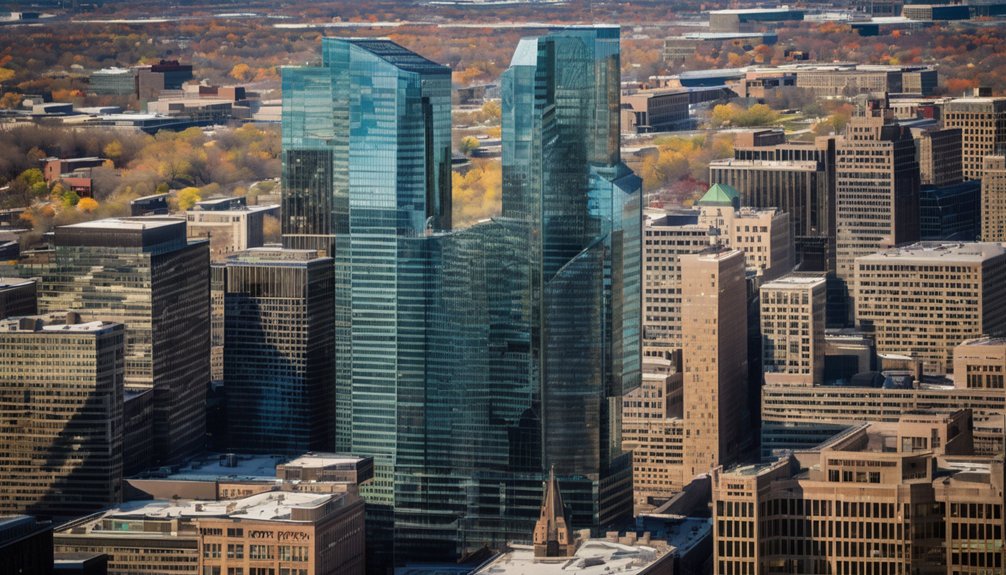
While it’s tempting to treat later sale prices as a proxy for what the IDS Center “cost,” those numbers actually reflect changing market conditions, financing climates, and investment cycles rather than the original construction bill.
When you see headlines about $253 million or $277 million deals, you’re looking at what investors paid decades after the tower opened, not what it took to put steel and glass in the ground.
Several moving parts distort the picture:
- Market timing – The 2006 sale (about 9% above the 2013 price) captured pre‑2008 optimism, not construction expenses.
- Different buyers, different strategies – The Beacon/Harel/Menora Mivtahim joint venture in 2013 paid for income potential and stability.
- Assessed value vs. sale price – Hennepin County’s 2013 assessment of $193 million used tax rules, not investor enthusiasm.
- Ongoing capital spending – Accesso’s $5 million Crystal Court renovation in 2020 shows fresh money keeps flowing long after the ribbon‑cutting.
What 1970s Minneapolis Building Costs Reveal About IDS
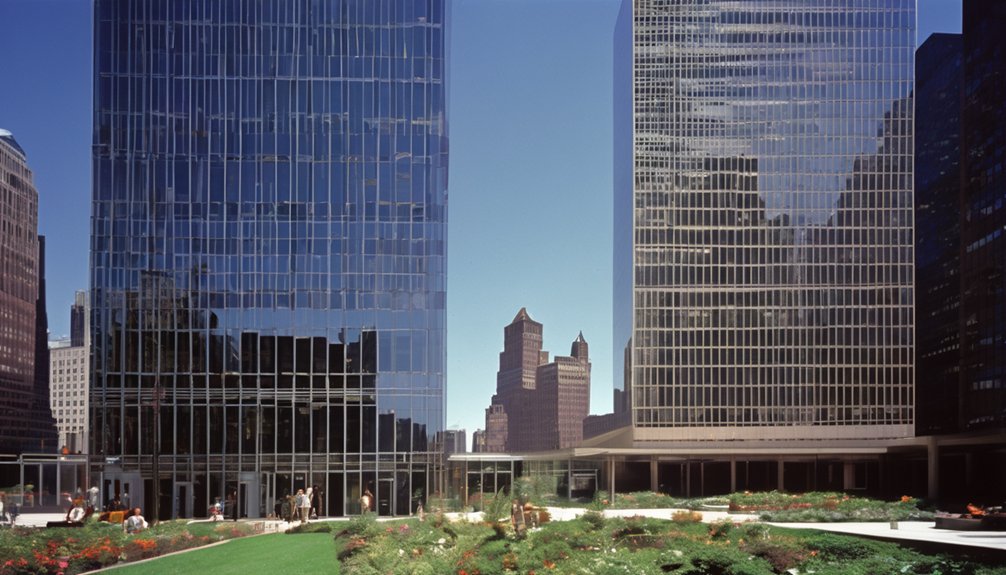
When you compare IDS’s $125 million price tag to other 1970s skyscraper budgets, you start to see how aggressive Minneapolis was about staking a claim on the national stage.
You’re not just looking at a number, though—you have to translate that cost into today’s dollars to grasp its true scale. In addition to its price tag, IDS’s postmodernist design signaled a shift away from the strict International Style toward a more expressive, historically aware architecture.
Once you adjust for inflation, you can judge whether IDS was a bargain, a splurge, or right in line with its era.
Comparing 1970s Skyscraper Budgets
Although $125 million sounds abstract on its own, the IDS Center’s price tag only comes into focus when you stack it against other Minneapolis skyscraper budgets of the 1970s.
You’re not just looking at a tall building; you’re looking at a 1.4‑million‑square‑foot commitment to remake downtown’s economic core in one shot.
When you compare IDS to its peers, four cost drivers stand out:
- Scale – 59 floors versus the mid‑rise projects Minneapolis was still approving.
- Mixed‑use program – Office, retail, and hotel space bundled into a single, costly complex.
- Signature design – Philip Johnson’s glass curtain wall demanded premium engineering and fabrication.
- Urban impact – Integrating with Nicollet Avenue and emerging skyways added complexity—and expense.
Inflation-Adjusted Cost Perspective
Even if the original construction budget for the IDS Center never made headlines as a single, tidy number, its real weight shows up once you translate 1970s dollars into today’s money. You’re looking at a project shaped by high inflation, oil shocks, and rapidly rising labor and material costs. By 1973, each construction dollar in Minneapolis stretched far less than it had just a few years earlier.
You can think of the IDS Center’s inflation-adjusted story this way:
| 1970s Reality | What It Means Now |
|---|---|
| Double‑digit inflation by 1973 | Every cost line swelled year to year |
| Glass curtain wall and skyways | Premium envelope and connection costs |
| Crystal Court and added equipment floor | Extra investment in public space and operations |
How Similar 1970s Skyscrapers Help Benchmark IDS’s Cost

To gauge what it really cost to build the IDS Center, you can look sideways at its 1970s peers—towers like Citicorp Center in Manhattan and the John Hancock Center in Chicago—which reveal how much steel, glass, and rentable floor area a developer could buy for a given dollar.
These buildings give you hard numbers and construction patterns that frame IDS in a real-market context rather than in isolation.
You can use three benchmarks together—Citicorp, John Hancock, and the older Empire State Building—to see how costs per square meter, rent expectations, and construction speed evolved by the time IDS went up.
- John Hancock Center: ~$100 million in mid‑1960s dollars, 260,000 m², about $3,076/m² in 2018 terms.
- Empire State Building: ~$40 million, 200,000 m², roughly $3,317/m² in 2018.
- Citicorp Center: Similar vintage urban megaproject, signaling 1970s cost norms.
- 1970s methods: Fast steel erection, integrated trades, and fireproofed frames constrained realistic cost ranges.
Our Best Estimate Of IDS Center’s Original Construction Cost

Those benchmark towers give you a useful frame, but the IDS Center’s own records point to a specific figure: about $125 million for the original project in early‑1970s dollars. That number comes from architectural and historical documentation and it covers the IDS Tower plus the Crystal Court complex as a single, integrated development.
You’re looking at roughly 1.4 million square feet of office, retail, and hotel space delivered over a three‑year build, from 1969 to 1972. For a 57‑story, Philip Johnson–designed skyscraper that helped reshape Nicollet Avenue and the downtown skyline, $125 million sits right in line with big‑city projects of that era.
Here’s how that cost breaks down at a high level:
| Aspect | Detail |
|---|---|
| Total original cost | ~$125,000,000 |
| Size covered by that budget | ~1.4 million sq ft mixed‑use space |
| Approximate cost per sq ft | About $90 in early‑1970s construction dollars |
Where To Find Original Records On IDS Center’s Construction Budget
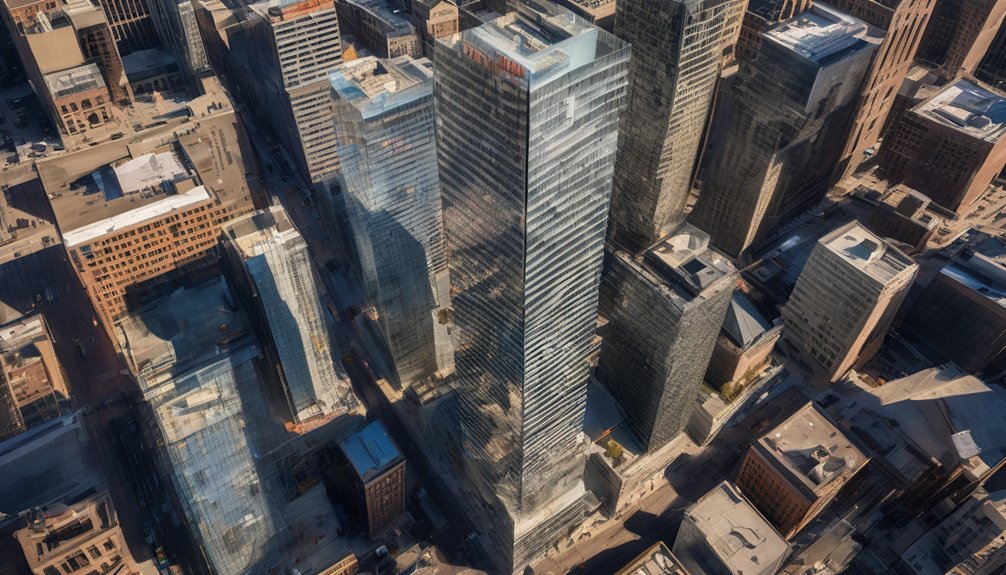
While the $125 million headline figure gives you a solid ballpark, pinning down the IDS Center’s original construction budget means digging into primary records scattered across archives, government offices, and old business files.
You’ll need to cross‑check multiple sources, because no single file neatly summarizes every cost decision from 1963 planning through the 1972 opening.
- Archival repositories – Start with the Minnesota Historical Society, Hennepin County Library’s Minneapolis Collection, and the Minneapolis Public Library’s Special Collections for downtown development and urban renewal financial reports.
- Architect and developer records – Consult the University of Minnesota’s Northwest Architectural Archives, Ed Baker’s papers, Ameriprise (IDS) archives, and later Oxford Development and John Buck Company files.
- Government documents – Review Minneapolis building permits, Hennepin County valuation records, state grants, HUD files, and zoning minutes.
- Published and digital sources – Use the IDS website, Business Journal, ProQuest, Newspapers.com, HathiTrust, and Google Books for corroborating figures.
Conclusion
You’ll probably never get a neat, single dollar figure for what the IDS Center cost, but you can still pin down a smart estimate. By comparing 1970s construction prices, similar towers, and later sales, you’ve seen how to separate myth from math. If you want the most precise answer possible, your next step is digging into original permits, contemporary news reports, and company records.