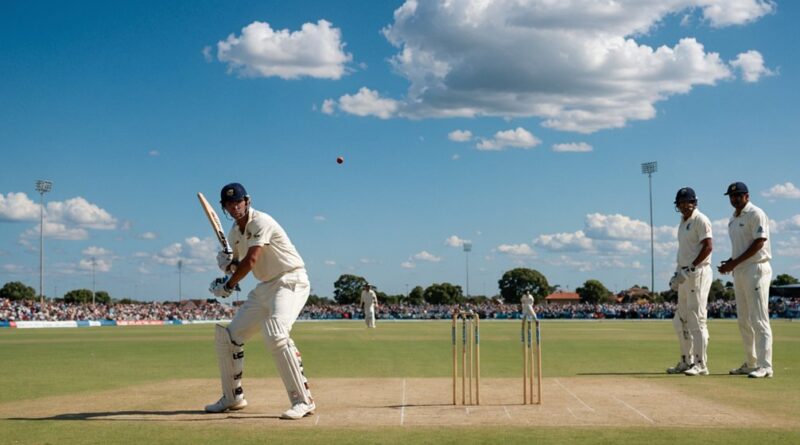
How Many Wickets Need to Fall for a Cricket Team to Be Declared All Out?
You need 10 wickets to fall for a cricket team to be declared all out. Cricket teams have 11 players, but you always need two batters at the crease, so once ten are dismissed the innings must end and the last batter is marked “not out.” All standard dismissals count toward this total. In some rare cases a side can be all out with fewer than ten wickets, and you’ll see how that works next.
Key Takeaways
- A cricket team is declared all out when ten wickets have fallen in that innings.
- Only ten wickets can fall because batting requires two players at the crease, leaving one batsman inevitably not out.
- Once ten batsmen are dismissed, the innings ends immediately, regardless of overs or time remaining.
- All valid dismissal types (bowled, caught, LBW, run out, etc.) contribute to the ten wickets.
- The ten-wicket all-out rule applies uniformly across all formats: Tests, ODIs, and T20s.
How Many Wickets Mean ‘All Out’ In Cricket?

In cricket, a team is considered “all out” when ten of its eleven batsmen have been dismissed, leaving no partner available for the final player at the crease. You see this in every format: once ten wickets fall, the innings ends immediately, regardless of remaining overs or time. All those dismissals together are often referred to collectively as the team’s fall of wickets.
Each dismissal’s called losing a wicket. After a wicket falls, the ball’s dead, so you can’t score further runs from that delivery. The next batter walks in and replaces the dismissed one, and this cycle continues until ten wickets fall or an external limit, like overs or time, stops the innings.
You’ll often hear commentators say a team’s been “bowled out” or “dismissed” once the fielding side takes those ten wickets. At that exact moment of the tenth dismissal, the batting side’s innings is officially over, with one batter left not out and no capacity to continue.
Why Only 10 Wickets Fall When 11 Players Bat

You might wonder why a team of 11 can only ever lose 10 wickets, and the answer starts with how you always bat in pairs. In all formats of the game, from Test matches to T20 leagues, this same structure applies and helps maintain cricket’s competitive integrity across formats.
As you explore how many dismissals are actually possible, you’ll see that once 10 batsmen are out, no legal way remains to continue the innings.
You’ll also understand why the last player is recorded as “not out” and what that means for the scorecard and match strategy.
Batting In Pairs Explained
Although a cricket team has eleven players, batting always happens in pairs, which explains why only ten wickets can fall in an innings. You always need two active batsmen at the crease: a striker facing the ball and a non-striker. When one’s dismissed, a wicket falls and a new batsman walks in to restore the pair. This structure is why exceptional bowling feats like taking ten wickets in a single innings are so rare and celebrated in cricket history.
You move through the batting order this way, from openers to lower order, with each partnership’s runs adding to the team total. Strike rotates between you and your partner at the end of each over or when you run.
The pair only breaks when one of you gets out. Once the tenth wicket falls, there’s no partner left to join the remaining batsman, so the innings ends.
Maximum Possible Dismissals
Ten dismissals are the absolute maximum in a cricket innings because the game’s laws always require two batsmen at the crease, and a team only has eleven players. You can use all 11, but once 10 are out, no one’s left to partner the remaining batter, so the innings must end. This limit holds true even though the MCC recognizes 11 official types of dismissals, because no matter how a batter gets out, the innings still ends once ten wickets have fallen.
Here’s why you never see 11 wickets fall:
- You always need two batsmen in the middle, and the Laws don’t allow the last player to bat alone.
- The fall of the 10th wicket automatically makes the side “all out,” whether in Tests, ODIs, or T20s.
- Dismissal precedence (bowled overrules others, stumped over run out) guarantees each ball only yields one wicket, capping the innings at 10 dismissals.
Not-Out Batsman Scenario
Maximum possible dismissals explain the limit of 10 wickets, but the not-out batsman at the end of an innings often causes confusion. You field 11 players, yet your innings ends once 10 wickets fall because the game always requires two batsmen at the crease. When the tenth wicket falls, one batsman simply has no partner left, so they’re not out but can’t continue. Modern LED wickets also help umpires confirm when a wicket has actually been put down in such dismissal situations.
| Aspect | Key Point | Effect on Innings |
|---|---|---|
| Batting structure | Two batsmen must be at the crease | Lone batsman can’t continue |
| Wicket counting | Each dismissal = one wicket | Maximum of 10 dismissals |
| Partnerships | 1st to 10th only | 10th partnership ends innings |
| Formats | Test, ODI, T20 identical | “All out” always means 10 down |
Thus, 11 can bat, but only 10 can be dismissed.
What Dismissals Count As Wickets Toward ‘All Out’?

Several different dismissal types can remove a batter, but only those that legally put a wicket “down” during live play count toward a team being all out.
In every valid dismissal, you must see the wicket broken: the bails fully off, or a stump out of the ground, while the ball’s still in play and the umpires accept the appeal.
Here’s what always adds to the wicket tally:
1. Standard dismissals – Bowled, caught, LBW, run out, and stumped all count, as long as the wicket’s put down correctly.
Precedence applies: if you’re bowled, nothing else matters; if you’re cleanly caught, it’s out caught, not run out.
2. Rare dismissals – Hit wicket, obstructing the field, hit the ball twice, handled the ball (historical), and timed out all count as wickets.
3. Wicket-down requirement – Umpires must judge the wicket legally broken; wind, accidental contact, or a dead ball don’t produce a dismissal or a wicket.
How Can A Team Be All Out With Fewer Than 10 Wickets?

Although a scorecard usually shows 10 wickets down when an innings ends, the batting side can technically be “all out” with fewer dismissals under specific laws and rare match situations. You need two batters at the crease; if that becomes impossible, the innings ends even without 10 conventional wickets.
A retired hurt player doesn’t count as dismissed, but if they can’t return in a final-innings chase, you can lose with one batter short. With “retired absent ill or injured,” the missing player effectively becomes a dismissal, so your team’s all out even though one spot in the batting order never appears.
You can also see strange collapses from rare dismissals and overlapping incidents:
| Scenario | What Happens | Effect on ‘All Out’ |
|---|---|---|
| Retired hurt | Spot left vacant | Can’t field full 10 batters |
| Retired absent | Counts as dismissal | All out with fewer appearances |
| Multiple run outs | Two fall from one ball | Line-up thins rapidly |
| Obstructing / hit twice | Unusual dismissals still count | Accelerates reaching all out |
How ‘All Out’ Works In Tests, ODIs, And T20s
In every major format of cricket—Tests, ODIs, and T20s—the basic idea of being “all out” stays the same: once 10 of your 11 batters are dismissed and only one is left at the crease, your innings must end because you can’t bat with a lone player.
Two batters must always share the pitch as striker and non-striker.
In Tests, you get up to two innings. Each innings ends the moment the tenth wicket falls, no matter how much time or how many overs remain. That’s the natural handover from your batting to the opposition’s.
In Tests, once the tenth wicket falls, that innings ends instantly—regardless of time or overs remaining
In limited-overs cricket, overs cap your innings, but all out still ends it early:
- ODIs (50 overs) – Your single innings stops when you’re all out, even if you’ve faced far fewer than 50 overs.
- T20s (20 overs) – The same rule applies in just 20 overs.
- Across formats – All out is always compulsory, never optional.
How Does Being All Out Affect Who Wins: And By How Much?

Once you understand what “all out” means, you can see how it directly shapes who wins and by what margin.
You’ll measure victories either by how many wickets a chasing team has left, or by how many runs the all-out side falls short.
You also can’t ignore rare but decisive penalty runs, which can flip the result even after a team’s ten wickets are gone.
Winning With Wickets Remaining
When you’re chasing a target, the match result flips between “win by wickets” and “lose by runs” depending on a single question: did your team get all out or not?
If you pass the target with wickets in hand, you win by wickets; if you’re all out short, you lose by runs instead.
In an 11‑player side, you start with 10 wickets. Your wickets margin is simply 10 minus the number you’ve lost when you reach the target.
- If Team A makes 200 and you reach 201 for 4, you win by 6 wickets.
- More wickets remaining usually means a more dominant chase.
- Very rarely, penalty runs can push you past the target even after you’re all out.
Losing By Runs Margin
Although it might feel like wickets decide everything, the margin of defeat in a failed chase is all about runs. Once you’re all out while chasing, your innings ends on the spot, and the scorer compares your total to the target. If you’ve made fewer, the fielding side “wins by X runs,” where X is the difference between the scores.
Your last wicket falling fixes your total forever. You can’t scramble extra runs; the deficit hardens. A chase of 200 that finishes 192 all out becomes a loss by 8 runs, no mention of “all out” in the official result.
| Moment | What It Feels Like |
|---|---|
| 1 run short | Agonisingly close |
| 50 runs short | Clearly outplayed |
| 150 runs short, all out | Utter collapse, shell-shocked |
Penalty Runs Changing Outcomes
Runs still decide the result, but penalty runs can quietly rewrite the numbers even after a team’s all out. Once you’ve lost 10 wickets, your innings is frozen: no more batting, no matter how many overs remain or how close you’re to the target.
But umpires can still punish the fielding side, even after you’re all out, by adding penalty runs to your total. Those five-run chunks don’t revive your innings, yet they can reshape the margin, or even the result.
- Narrowing defeats – Penalty runs post-all-out reduce the winner’s margin by the exact total awarded.
- Forcing ties – If penalties equal the original run deficit, the match becomes a tie.
- Amplifying pressure – Bowlers know lapses can erase hard-won advantages.
Scorecard Examples Showing All Out And Match Results
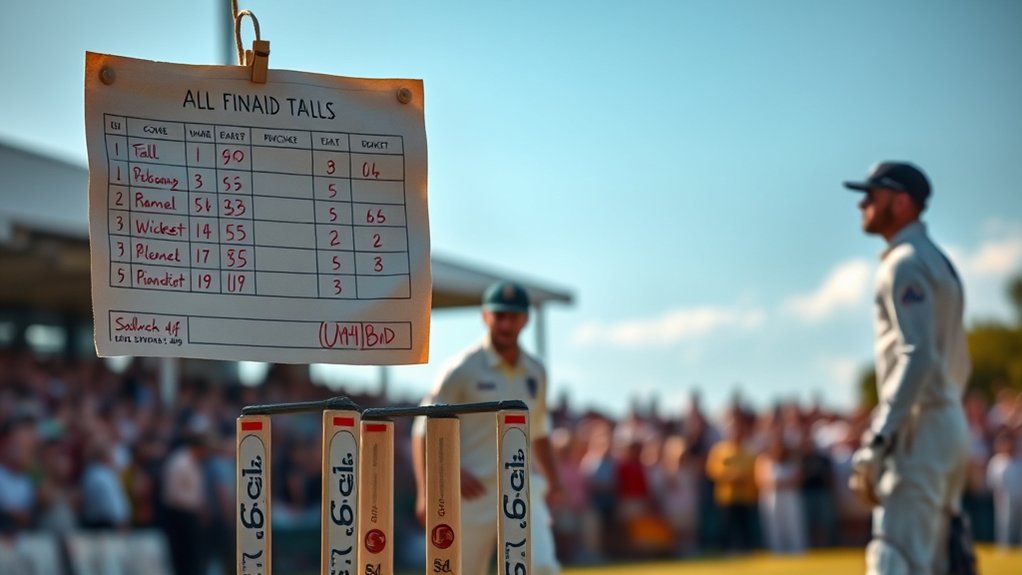
Scorecards clearly show how a team becomes “all out” and how that shapes the match result, whether it’s a Test, ODI, T20, injury-hit innings, or a Super Over.
In a Test, you might read: Australia 60 all out (10 wkts, 20.3 overs), England leading so strongly that they win by an innings and 5 runs. One glance tells you all 10 wickets fell quickly and decisively.
In ODIs, “117 all out (10 wkts, 26.1 overs)” for India shows they didn’t bat out 50 overs, letting South Africa cruise to a 7‑wicket win.
In T20s, “138/10 (19.5)” for England tells you they used almost the full 20 overs but still lost comfortably.
You’ll also see exceptions: “200/9 (injured player)” signals an injury‑induced all out, while a Super Over reads “10/2 (1 over)”—only two wickets, but still all out and match decided.
Famous All Out Collapses And Record-Low Team Totals

Few moments in cricket grip you like a full‑scale batting collapse, when a team hurtles from control to “all out” in a blur of wickets and disbelief.
Record‑low totals turn the simple idea of ten wickets into a brutal countdown, where every mistake feels final.
Here are three striking examples that show how fast “all out” can arrive:
- India’s 36 all out at Adelaide in 2020: you watched a solid position vanish in 21.2 overs as Josh Hazlewood’s 5‑8 and Pat Cummins’ 4‑21 shredded the innings; Mayank Agarwal’s nine was the top score in India’s lowest Test total, the game ending inside three days.
- Australia’s reply in that pink‑ball Test: even after 191 all out, Tim Paine’s unbeaten 73 and a last‑wicket surge of 80 runs showed how fragile and reversible momentum can be.
- Wirral CC’s three all out: at club level, you see the same drama condensed into almost nothing, a collapse so extreme it challenges the record books.
Rare ‘All Out’ Exceptions And Penalty Run Scenarios

Those dramatic collapses highlight how brutally simple “ten wickets and you’re done” can feel, but the Laws also hide a handful of rare situations where an innings ends or changes shape in ways you might not expect. Once the 10th wicket falls, you’re all out instantly, even if overs remain; the last batter can’t continue alone, so any run they’d try to complete simply can’t exist in Law.
Penalty runs then add another layer. They don’t change how many wickets you’ve lost, but they can swing the score right as an innings closes.
| Situation | What actually happens |
|---|---|
| Deliberate short runs | Warning first, then runs cancelled + 5 to the fielding side |
| Ball hits fielder’s unattended helmet | 5 penalty runs to you, recorded as extras |
| No‑ball plus penalty situation | The no‑ball run stands, and 5‑run penalties stack on top |
All completed runs and penalties stand when that 10th wicket finally falls.
Conclusion
Now you know exactly what “all out” means, how 10 wickets work with 11 batters, and why some dismissals count while others don’t. You’ve seen how teams can be bundled out early, how it changes results, and what those dramatic collapses look like on a scorecard. Next time you’re watching, you won’t just follow the total—you’ll understand the tension behind every wicket and what being all out really costs a team.