Is the Benzini Brothers Circus Real or Fictional?
You won’t find the Benzini Brothers Circus in any archive because it’s a fictional circus created by Sara Gruen for *Water for Elephants*. However, you’ll notice it feels real because Gruen based its trains, animal acts, and harsh worker conditions on authentic 1930s circus history and on-the-ground research. She contrasts this small, desperate outfit with the real Ringling Bros. Circus, and you can see how that contrast exposes life in the Great Depression.
Key Takeaways
- The Benzini Brothers Circus is entirely fictional, created by author Sara Gruen for her novel *Water for Elephants*.
- No historical records, archives, or circus histories document a real Benzini Brothers Circus.
- In the novel, Benzini Brothers serves as a struggling Depression-era rival to the real Ringling Brothers Circus.
- Gruen’s extensive research into real 1930s circuses makes Benzini’s operations and conditions historically realistic despite being invented.
- Fan sites, literary analyses, and interviews consistently describe Benzini Brothers as a fictional circus grounded in authentic period details.
Is Benzini Brothers Circus Real or Fictional?
Surprisingly, the Benzini Brothers Circus isn’t a real historical circus at all but a fictional creation from Sara Gruen’s novel *Water for Elephants*.
When you read about its roaring crowds, chaotic back lot, and grimy train cars, you’re not encountering a lost American show but an invented one. Literary analyses explicitly classify Benzini Brothers as fictional, and no historical records list it among real circuses. In the novel, the circus travels globally, echoing the wandering, expansion‑driven spirit associated with 1920s circus life.
You can spot this by how the book contrasts Benzini Brothers with the Ringling Brothers Circus.
Ringling was a documented giant of the industry; Benzini Brothers is portrayed as a struggling rival that never existed outside the novel.
Fan sites, YouTube breakdowns, and blogs all describe it as Depression‑era fiction, not a forgotten troupe.
Even Wikipedia’s plot summaries avoid treating it as factual history.
You’re meant to experience Benzini Brothers as a convincing illusion, not a recoverable piece of circus lore.
How Sara Gruen Used Real Circus History
Although the Benzini Brothers Circus is fictional, Sara Gruen anchors it so firmly in real circus history that it feels like a forgotten troupe instead of an invention. You can see this in how she builds the world from documented details: Depression‑era train travel, cramped quarters, and the brutal dangers of life on the rails. She didn’t guess; she interviewed performers, combed rare memoirs, and walked museum exhibits in Baraboo and Sarasota. Her research also extended to the Jamaica Ginger Extract tragedy, weaving in the paralysis caused by adulterated patent medicine that devastated tens of thousands of poor and immigrant drinkers in the 1930s.
| Research Focus | Historical Source |
|---|---|
| Train operations | Traveling circus archives |
| Performer life | Interviews and period articles |
| Elephant behavior | Zoos and sanctuaries |
| Depression‑era detail | Rare circus books |
| Visual atmosphere | Museum photos |
When you read about Benzini’s chaotic jumps, violent enforcers, or cramped menagerie cars, you’re stepping into practices historians have already recorded. Even Rosie’s quirks grow from Gruen’s hours with real elephants, especially Nosie from the Kansas City Zoo, so the novel’s most dramatic moments still rest on a researched foundation.
How Does Benzini Brothers Differ From Ringling Bros.?
When you compare the Benzini Brothers Circus to Ringling Bros., you’re really weighing a fictional, Depression-era outfit against the most powerful real circus brand in American history.
You see sharp contrasts in scale and prestige: Ringling ran massive, multi-unit shows, while Benzini exists as a single, struggling operation. Unlike the grand spectacle of Ringling, the Benzini Brothers Circus is a single, struggling operation that relies on modest means and simple attractions, much like a small troupe selling themed t-shirts rather than running a vast entertainment empire.
Those differences shape Jacob’s journey, because his coming-of-age unfolds not under the polished glare of a circus empire, but within the precarious world of a failing, morally fraught show.
Fictional Versus Historical Circus
Even though Benzini Brothers Circus feels vivid and historically grounded in *Water for Elephants*, it’s entirely fictional, while Ringling Bros. was a real, documented circus giant of the same era.
You’re looking at two very different kinds of circuses: one invented to tell a story, the other preserved in archives, posters, and news reports. Gruen’s research into 1930s traveling circuses helps Benzini mirror the real historical circuits that shows like Ringling actually traveled.
Benzini exists only on the page, yet it moves through the same 1920s–1930s landscape that real traveling shows like Ringling did.
Gruen built Benzini from intensive research, borrowing authentic details of circus work, slang, and routine.
That’s why you sense truth in Jacob’s mud, sawdust, and moral compromises, even though no Benzini ledgers, payrolls, or route books exist—only Ringling’s do.
Operational Scale And Prestige
Set against Ringling Bros.’ sprawling, polished empire, the Benzini Brothers Circus runs as a scrappy, second-rate mudshow that survives by cutting corners.
You see a small outfit rattling from town to town by train, with a handful of animal acts, performers, and “freaks,” always one stampede or broken act away from shutting down. It hires whoever’s available—like Jacob—to cover jobs a premier show would staff professionally. In the end, Jacob and Marlena escape to Ringling, underscoring how far Benzini falls short of its more prestigious rival.
Ringling, by contrast, operates as the gold standard: massive troupes, multiple tents, global tours, and full veterinary teams that signal money and stability.
Where Ringling projects reliable spectacle and longevity, Benzini projects instability and desperation. Its boastful motto, “Most Spectacular Show on Earth,” lands as bitterly ironic once you measure it against Ringling’s real prestige and scale.
Role In Jacob’s Journey
Measured against Ringling’s polished empire, Benzini Brothers doesn’t just look smaller; it reshapes Jacob’s entire path. You watch him jump from orphaned veterinary student into a chaotic, morally murky world where his skills suddenly define his place.
This shabby circus becomes the crucible where he learns animal care under pressure, sees the “illusion” of entertainment stripped bare, and forges bonds with Camel, Marlena, and Rosie.
Because Benzini is fictional, Gruen can push Jacob through extremes—corrupt bosses, brutal practices, and the circus’s collapse—without historical constraints.
Ringling, by contrast, stays mostly offstage, a destination more than a drama. It represents stability, legitimacy, and Jacob’s eventual professional life, while Benzini embodies risk, transformation, and the harsh education that gets him there.
Real Circus Practices Reflected in Benzini Brothers
When you look at the Benzini Brothers’ train snaking across the country, you’re seeing logistics that match how real 1930s circuses moved people, animals, and equipment by rail.
You also encounter workers whose jobs—roustabouts, performers, laborers, and even a circus vet—reflect the harsh hierarchy and precarious employment of the era.
As you consider these details, you can gauge how closely the novel tracks authentic circus operations behind the big top glamour.
Authentic 1930s Circus Logistics
Although the Benzini Brothers Circus is fictional, its day‑to‑day operations mirror how real American circuses ran in the 1930s: everything revolved around the train. You see the show jump from town to town as a classic “mudshow,” parking on the outskirts, unloading tents, wagons, and animals, then vanishing overnight.
That constant motion reflects how Depression‑era circuses survived: they chased new audiences because they couldn’t rely on any one struggling community.
You also watch the harsh logistics behind the spectacle. Elephants like Rosie ride in animal cars, managed with stakes and hooks; horses and menagerie stock depend on a traveling vet for emergency care.
When Benzini collapses, its animals and equipment scatter to bigger outfits, echoing real shutdowns and asset liquidations.
Realistic Worker Roles Portrayed
Just as the Benzini Brothers’ trains and tents mirror authentic 1930s circus logistics, the people running that machinery reflect real jobs and power structures from the era.
You see veterinarians and animal handlers constantly triaging injured horses, big cats, and elephants, just as real traveling circuses relied on medical expertise to keep exhausted, overworked animals performing.
You also feel the economic desperation of roustabouts and performers who can’t afford to quit, even when pay’s unfair and conditions are dangerous.
Management controls where you sleep, when you move, and whether you eat, echoing documented coercion and limited worker autonomy.
Hazards—falling from trains, equipment accidents, makeshift first aid in remote towns—anchor Benzini’s worker roles in historically accurate risk and exploitation.
1930s Circus Life Behind the Fictional Circus
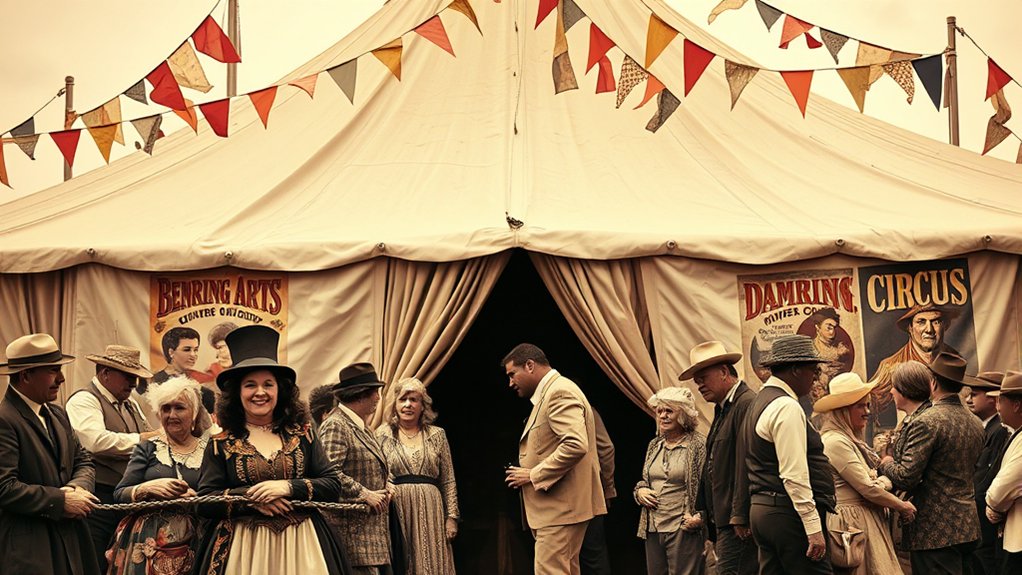
You’d see multiple shows a day, from noon to night, because management had to wring every dollar from each town.
Outside the big top, free menagerie previews—camels, elephants, caged big cats—tempted you to stay and pay.
Inside and out, chorus lines, sideshows, and animal acts filled a packed schedule, all designed to pull hard‑earned coins from thin Depression‑era wallets.
Are the Characters Based on Real People?
Marlena doesn’t match any documented performer either. She reflects the skilled equestrians and animal riders you’d have found on a 1930s lot, but her marriage to August and later life with Jacob exist only in the novel’s world.
August and Uncle Al also don’t line up with specific historical showmen. They embody the charismatic, sometimes brutal bosses and owners who chased prestige at any cost.
In each case, you’re meeting characters grounded in the period’s realities, not thinly disguised versions of real, traceable people.
How the Train and Animals Make the Circus Feel Real
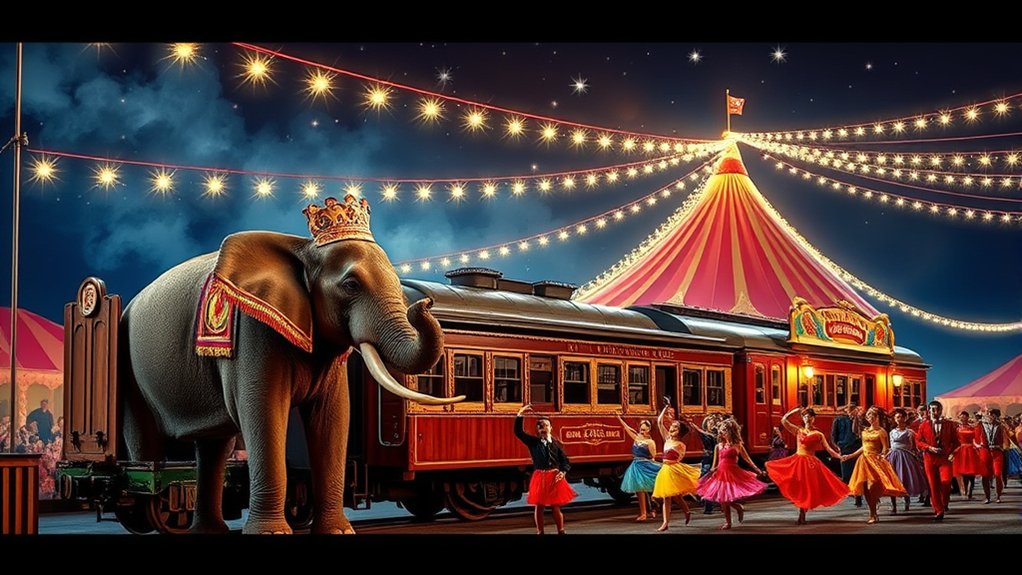
When you picture the Benzini Brothers circus, you’re not just imagining a tent—you’re riding the gritty train routes and watching lifelike animal routines unfold.
You can feel the cramped railcars, midnight jumps, and constant motion that echo how real 1930s circuses crisscrossed the country.
At the same time, the daily care, performances, and even mistreatment of animals like Rosie make the show’s spectacle feel uncomfortably authentic.
Gritty Train-Route Details
Although the Benzini Brothers circus is fictional, its grinding progress along the rails feels real because it mirrors how 1930s circuses actually lived and worked out of their trains. You move through cars crammed with canvas, rigging, performers, workers, and cages, just as real Depression‑era outfits did when rail travel dominated touring entertainment.
You sense the schedule’s relentlessness: jump the town, ride overnight, unload at dawn, perform, repeat.
Because everyone and everything rides together, you feel how the train itself becomes a rolling town. The novel’s routes echo authentic long-haul circuits that let circuses reach scattered communities despite economic hardship.
As you follow Jacob from car to car, you’re tracing historically accurate logistics that ground the story’s invented drama in real 1930s movement.
Lifelike Animal Routines
Boxcars packed with crates, hay, and the heavy breath of animals turn the Benzini Brothers’ fictional circus into something that feels intensely real. You don’t just watch the circus move; you feel its weight as elephants, horses, and dogs rattle across Depression-era tracks.
The train becomes a rolling menagerie, echoing how real mudshows traveled. You see Rosie the elephant loaded like essential cargo, Marlena’s horses shifting in straw, Queenie trotting the aisles.
Their routines—feeding, grooming, rehearsing, even suffering abuse—mirror historical accounts of circus life. Through Jacob’s veterinary work, you glimpse infections, injuries, and hurried fixes before showtime.
These practical tasks, tied to the train’s timetable, make the animal acts feel like operations, not fantasy.
Why the Benzini Brothers Circus Shuts Down in the Story
As the violent chaos of the stampede rips through the Benzini Brothers Circus, the show collapses in a single, catastrophic night. You watch Rosie, brutalized for so long, finally strike back, driving a stake into August’s head. His body disappears under panicked hooves. No one else truly sees what you see, but the truth shatters the circus from within.
With August dead and Uncle Al soon found garroted, leadership evaporates. The Benzini Brothers outfit can’t survive that kind of loss or the public scandal that would follow. Operations stop in the dust and screams.
| Loss | What You Feel |
|---|---|
| August’s violent end | Shock mixed with justice |
| Uncle Al’s corpse | Numb, anxious dread |
| Animals scattering | Grief and responsibility |
| Tents left empty | Strange, fragile hope |
You leave with Marlena, Rosie, Queenie, and the horses, stepping away from the wreckage toward a different life.
Benzini Brothers as Historical Fiction
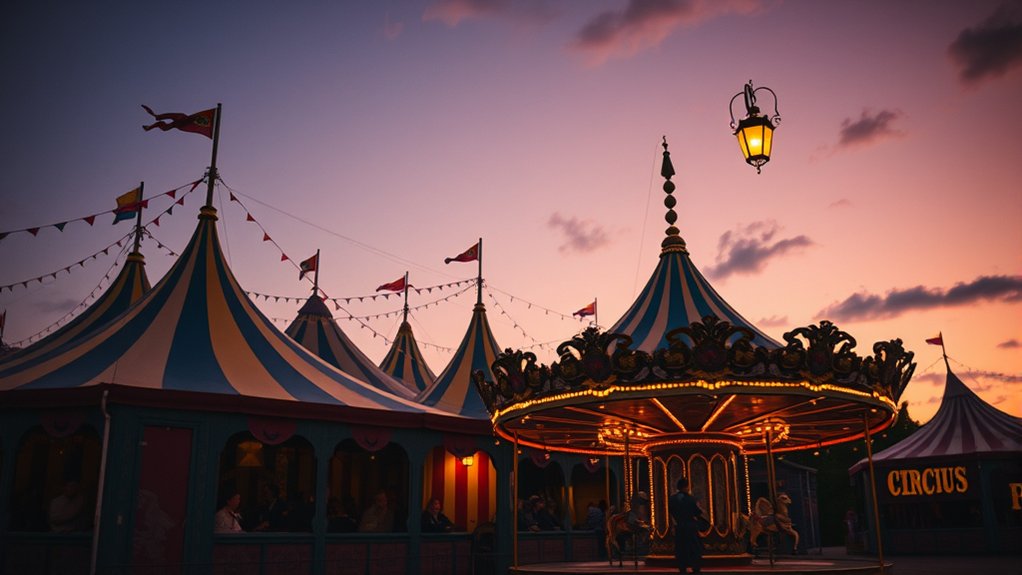
While the Benzini Brothers Circus never existed outside the pages of *Water for Elephants*, it feels rooted in reality because Sara Gruen builds it from the bones of real Depression‑era train shows. You’re not reading a secret history of a lost circus; you’re stepping into carefully crafted historical fiction that mirrors how 1930s mudshows actually ran.
Gruen bases Benzini Brothers on documented practices of outfits like Ringling Brothers, then frees herself by inventing a rival line. That choice lets her blend researched anecdotes—railcar hierarchies, dangerous lot work, brutal discipline, and animal abuse—into a single, coherent narrative without pretending it’s a true story.
As you follow Jacob Jankowski onto the circus train, you move through a setting that matches the period: entire shows traveling on rails, workers and animals jammed into cars, routes crisscrossing the country.
The characters are fictional, but their world runs on historically accurate tracks.
What Benzini Brothers Reveals About Life in the Great Depression
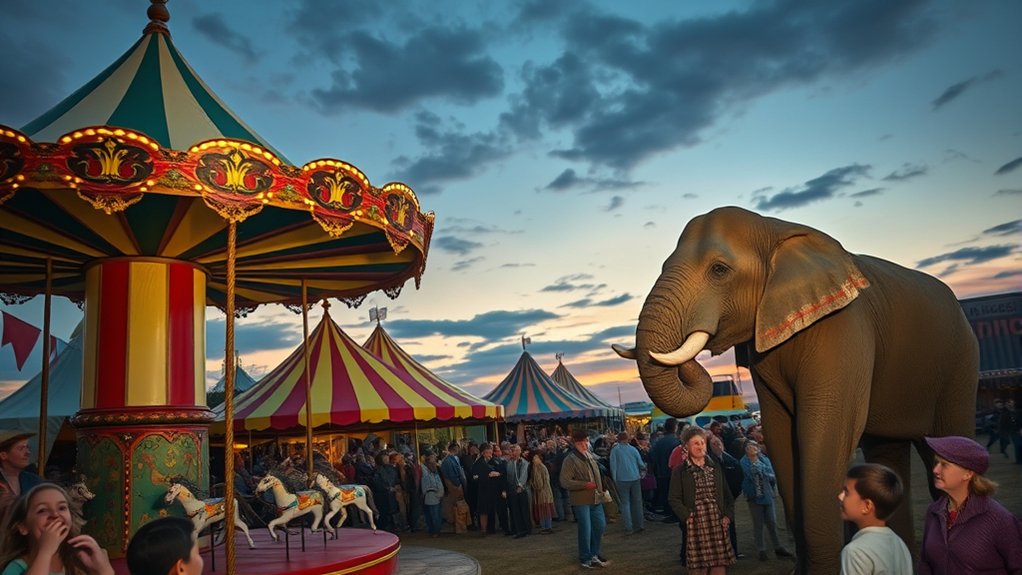
Even though Benzini Brothers is fictional, its grim circus train becomes a moving cross‑section of Great Depression life: cramped, cash‑strapped, and always on the brink. You live jammed into a railroad car, sharing bunks, storing only what fits in a tiny space.
The train holds your kitchen, laundry, and costume cleaning—an entire town squeezed onto iron wheels that never really stop.
You feel the larger collapse in every missed paycheck and shrinking crowd. As real circuses burned wagons, sold property, and folded, your own show staggers from foreclosure to disaster, mirroring families losing farms and parents overnight.
Mobility looks glamorous, but you’re rootless—rolling from midway to midway, chasing nickels from people as desperate as you.
Behind the tents, exploitation thrives: brutal labor, unsafe big tops, trafficked “oddities,” and animals suffering injuries you’re barely trained to treat. Survival means accepting danger as routine.
Frequently Asked Questions
Can I Visit a Real-Life Circus Inspired Specifically by Benzini Brothers Today?
You can’t visit a circus officially modeled on Benzini Brothers, but you can see the *Water for Elephants* musical, tour Circus World Museum, or attend traditional big-top shows that echo its gritty Depression-era atmosphere.
Did Any Lawsuits or Controversies Arise From Gruen Inventing Benzini Brothers Circus?
No, you won’t find any lawsuits or controversies tied to Gruen inventing Benzini Brothers. You can safely treat it as pure fiction—no real circus sued, no historians objected, and no public scandals emerged.
How Accurate Is the Novel’s Portrayal of Circus Finances and Ticket Sales?
You’ll find the novel largely accurate: it portrays thin profit margins, huge train and animal costs, dependence on ticket sales, regional demand swings, and worker desperation in line with Depression‑era circuses, though some drama’s heightened.
What Primary Historical Sources Did Sara Gruen Rely on for Her Circus Research?
You learn Gruen didn’t cite specific archives; instead, she dug into Depression‑era circus histories, Ringling Bros. research, oral histories, veteran anecdotes, and reports of murders, train throw‑offs, animal abuse, and worker mistreatment to ground her fiction.
Has Benzini Brothers Circus Influenced Later Books or Films About Traveling Circuses?
Yes, you’ll find Benzini Brothers’ gritty atmosphere echoing through later circus novels and films. You’re seeing its influence whenever creators highlight Depression-era mudshows, abusive management, brutal labor, and the fragile community of transient performers and animals.
Conclusion
You walk away from Benzini Brothers knowing it isn’t a real circus, yet it still feels true. Gruen blends real 1930s circus history, brutal animal practices, and Depression‑era hardship so well that you can almost smell the hay and greasepaint. As you ride that fictional train, you’re really touring America’s darker corners—where entertainment, survival, and cruelty collide, and where a made‑up circus reveals very real truths about the past.