What Are the Benefits of Virtual Reality? Complete Overview
You gain powerful benefits from virtual reality because it fully engages your senses, making digital worlds feel real and memorable. You can learn faster, practice complex skills safely, and explore places or activities you can’t easily reach in everyday life. VR also supports medical training, patient recovery, remote collaboration, and even more motivating workouts. It often saves time, money, and travel while boosting focus, confidence, and retention—plus, it offers many surprising uses you might not expect.
Key Takeaways
- VR delivers highly immersive entertainment and fitness experiences that increase engagement, motivation, and measurable health benefits compared to traditional media and exercise.
- In education and training, VR safely simulates real-world scenarios, significantly improving skill acquisition, practice opportunities, and long-term knowledge retention.
- Healthcare uses VR to reduce patient anxiety, enhance surgical planning, support medical training, and lower stress for clinical teams during complex procedures.
- VR enables remote collaboration, virtual tourism, and accessibility to experiences and locations otherwise limited by distance, cost, or physical ability.
- Despite higher upfront costs, VR and mixed-reality deployments often achieve strong ROI through reduced travel, scalable training, and new revenue from immersive attractions.
How VR Works (And Why It Matters)
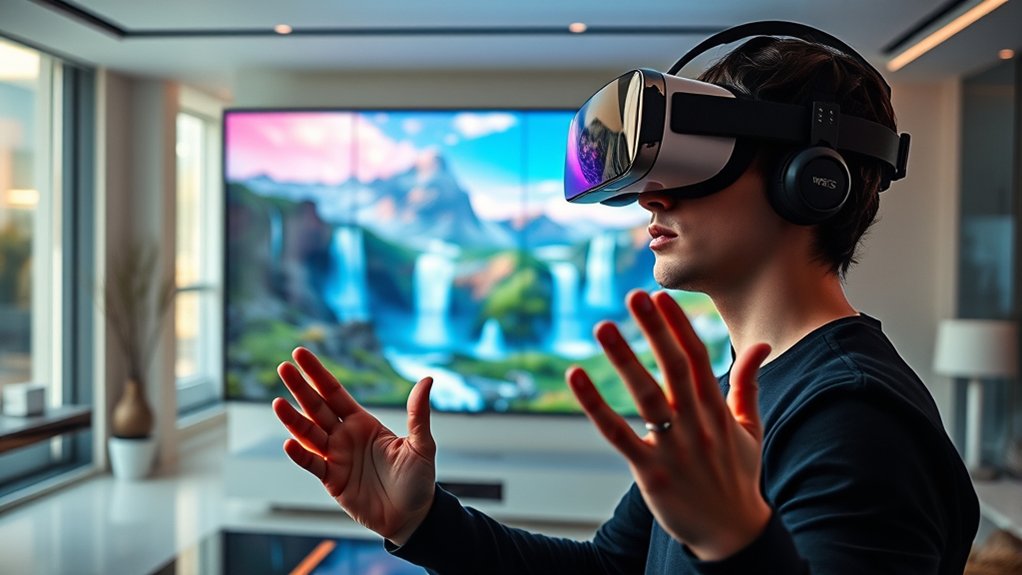
Even though it can feel like science fiction, virtual reality is just a tightly coordinated system of hardware and software working together to convince your brain that a digital world is real.
Your headset’s high-resolution displays and lenses feed each eye a slightly different image, using stereoscopy, binocular disparity, and motion parallax to create depth. A wide field of view plus high frame rates keeps the scene stable and believable. This visual setup, combined with 3D spatial audio, helps create a more convincing and immersive sense of presence.
High‑resolution displays and subtle eye differences create convincing depth, while wide views and high frame rates anchor the illusion
Inside the headset, gyroscopes, accelerometers, and magnetometers track how you rotate and move, while cameras and external sensors follow controllers, hands, or your whole body.
Powerful GPUs then render updated 3D graphics in real time, matching every subtle motion.
Spatial audio engines place sounds above, behind, or beside you, and haptic controllers, gloves, or suits push back with vibration, resistance, or impact.
When latency stays low and everything stays in sync, your brain accepts the simulation as a coherent, “real” place.
Top Benefits of VR in Everyday Life
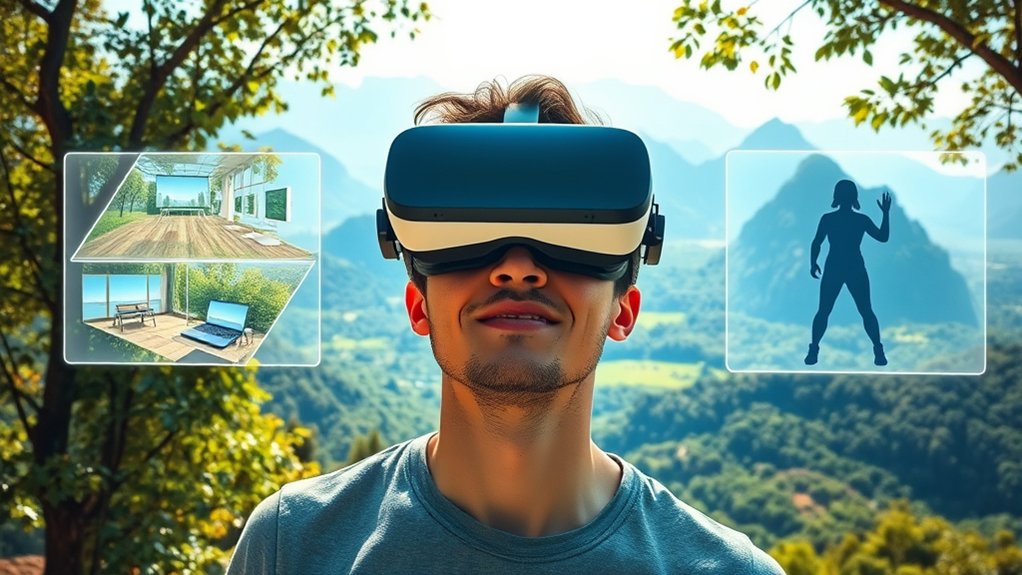
While VR started as a futuristic curiosity, it’s quickly becoming a practical tool that improves everyday life in tangible ways. You can step straight into your favorite games, movies, or concerts, feeling present inside richly detailed worlds instead of just watching a screen. You might ride virtual rollercoasters, skydive, or explore outer space without any real danger. VR is also increasingly used to enhance education, transporting students to historical events or complex environments and helping them learn through immersive, hands-on practice.
VR also supports your well-being. Immersive relaxation apps help you meditate on a quiet beach or in a forest, blocking out distractions. Clinically validated VR therapies can ease anxiety, phobias, PTSD symptoms, and even chronic pain by redirecting your attention and safely exposing you to triggers.
On the social side, VR lets you meet friends and family in shared virtual spaces, no matter where they live. If you’re isolated, shy, or have mobility limits, you can still join communities, attend events, and explore distant places together.
How VR Transforms Learning and Training

You’re no longer limited to passive lectures when you can step into immersive classroom experiences that surround you with interactive, 3D content. In VR, you safely practice complex or high-risk skills in realistic simulations, building competence without real-world consequences. This hands-on immersion accelerates knowledge retention, helping you learn faster and remember more than with traditional methods. By leveraging performance tracking, VR training can provide personalized feedback and adapt to each learner’s needs over time.
Immersive Classroom Experiences
As virtual reality moves from novelty to everyday classroom tool, it’s quietly reshaping how students engage with lessons, practice skills, and remember what they’ve learned. You’re no longer limited to slides and lectures. By surrounding learners with interactive 3D environments, VR engages multiple senses at once, which research shows can significantly boost knowledge retention.
Gamified lessons turn passive listening into active problem‑solving and teamwork, so students often forget they’re “in class” at all. Story-driven modules wrap complex concepts in narratives, helping learners recall ideas by linking them to characters and plot.
Inside shared 3D spaces, students sit around a virtual table, turn toward speakers, annotate shared boards, and hold quiet side discussions without derailing the group.
Because they apply knowledge in real time—collaboratively or competitively—learners build confidence faster and retain information longer than in traditional, flat-screen environments.
Safer Skills Practice
When real-world mistakes are too costly or dangerous, virtual reality lets you rehearse them safely until you get it right. You can run through fire safety drills in unbuilt buildings, or practice high‑risk procedures in policing, the military, or medicine without endangering anyone. Every mistake becomes data, boosting your confidence and readiness for real incidents. Because performance is tracked inside the headset, organizations gain measurable outcomes they can use to refine training, monitor improvement, and prove impact over time.
In VR, hazardous manufacturing or construction sites are accurately replicated, so you apply safety protocols and emergency procedures under pressure. Studies show this kind of training can cut workplace accidents by nearly half and increase safety awareness by around 30%.
Because simulations are scalable and reusable, you standardize instruction across locations, sharpen risk perception, build muscle memory, and strengthen a proactive safety culture while reducing long‑term training costs.
Faster Knowledge Retention
Although traditional training often fades fast, virtual reality turns learning into a vivid experience your brain actually holds onto. Instead of passively listening, you learn by doing inside realistic simulations that engage sight, sound, and movement. That active, multi-sensory practice combats the forgetting curve and makes new knowledge stick.
Studies back this up. In classrooms, VR has driven retention gains above 35%, while non‑VR barely moved. In language learning, unique VR contexts pushed one‑week recall above 90%. Surgical trainees using VR retained skills far better, and corporate learners felt dramatically more confident applying what they learned.
Because VR ties information to places, actions, and emotions, you recall it faster later—whether you’re in a real lab, on the job, or taking a test.
How VR Helps Surgeons, Therapists, and Patients

Rather than helping only the surgeon behind the scenes, modern virtual reality tools now support everyone involved in a procedure—surgeons, therapists, and patients alike. You see the impact most clearly in the operating room. Patients using VR during wide‑awake hand surgery report lower anxiety, need less sedation, and often recover faster because they’re not fighting lingering drug effects. Veterans in local‑only procedures also benefit from VR as a non‑drug calming tool.
VR doesn’t just soothe patients; it upgrades clinical performance and training. You can plan complex operations with 3D renderings, avoid critical structures, and rehearse rare procedures safely. Medical trainees using VR have shown dramatic performance gains and improved accuracy.
| Who Benefits | How VR Helps | Key Outcome |
|---|---|---|
| Patients | Immersive distraction | Less anxiety, less sedation |
| Surgeons | 3D planning tools | Higher precision |
| Trainees | Risk‑free practice | Faster skill growth |
| Therapists | Shared simulations | Better patient education |
| Care teams | Reduced stress | Smoother procedures |
VR for Gaming, Fitness, and Immersive Entertainment

Step into a VR headset and games, workouts, and movies stop feeling like content on a screen and start feeling like places you inhabit. You’re surrounded by high‑resolution visuals and spatial audio, so you move, react, and decide as if you’re really there.
This immersion sharpens spatial awareness, hand‑eye coordination, and problem‑solving as you navigate 3D spaces and tackle complex, non‑linear challenges.
In fitness apps, VR turns exercise into play. You box, dance, or swing a virtual racket, often reaching moderate‑to‑vigorous intensity that supports cardiovascular and muscular health.
Because the workouts feel like adventures, you’re more likely to stick with them, build endurance, and improve balance and coordination.
Studies on systems like Black Box VR show greater fat loss, muscle gain, and mood boosts compared with traditional or non‑immersive options.
VR for Accessibility, Virtual Travel, and Remote Access

With VR, you can explore destinations around the world, experience museums, and test tourist attractions without leaving home.
You also gain new forms of remote access to healthcare, education, and social spaces that might otherwise be hard or impossible to reach.
Together, virtual tourism and immersive remote access make everyday life more inclusive for people with diverse needs and abilities.
Virtual Tourism And Exploration
Although travel will always have a special pull, virtual reality now lets you explore the world in ways that break past the limits of distance, cost, and mobility. You can stand “inside” a city, museum, or coastal resort through 360-degree, high‑resolution previews that feel far more real than photos or videos. That emotional sense of presence builds trust, which is why hotels using VR tours see dramatic booking increases.
You’re not stuck in a fixed itinerary either. Interactive hotspots, gamified elements, and personalized paths let you wander at your own pace, compare rooms, explore neighborhoods, or immerse yourself in local history.
You save time and money while reducing environmental impact, using VR as a low‑carbon research tool that still inspires future in‑person trips.
Remote Access And Inclusion
Beyond using VR to preview your next vacation, the same sense of presence now reshapes how you work, learn, and connect from anywhere. Instead of flat video calls, you step into shared virtual offices with whiteboards, documents, and natural gestures that feel closer to face‑to‑face collaboration.
You reduce travel by up to 90%, cut costs, and shrink your carbon footprint while still high‑fiving teammates’ avatars.
VR also turns remote training into consistent, hands‑on practice you can access globally, even in hazardous or otherwise unreachable environments. Cheaper headsets and downloadable modules keep learning continuous during disruptions.
Asynchronous virtual rooms let you contribute across time zones, protect work‑life balance, and join distributed teams without relocating, expanding inclusion and opportunity.
VR for Design, Collaboration, and Productivity at Work
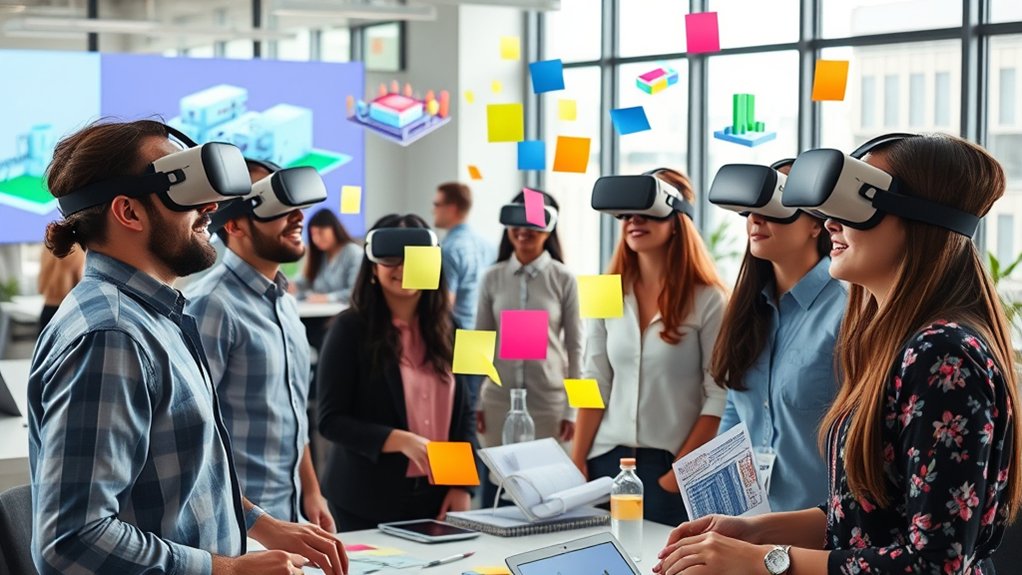
As work grows more distributed and complex, virtual reality turns scattered teams and abstract ideas into something you can stand inside, manipulate, and refine together. You meet as avatars, read body language, and sketch or grab 3D models in real time, instead of guessing from flat slides. Construction teams already cut costly RFIs by surfacing dozens of issues in just a few VR sessions.
| VR Benefit Area | What You Can Do | Practical Impact |
|---|---|---|
| Design | Inspect, edit, and stress‑test 3D prototypes | Fewer physical models; faster iterations |
| Collaboration | Co-create in shared virtual rooms | Clearer decisions; fewer RFIs and rework |
| Productivity | Block distractions and focus in immersive spaces | Higher output; shorter task times |
| Remote Work | “Teleport” to shared sites without travel | Lower costs and emissions; better balance |
| Innovation | Visualize data and ideas in 3D early | Faster insights; fewer 2D‑to‑3D missteps |
You don’t just talk about work—you step inside it.
Is VR Worth It for You? Costs, Risks, and ROI
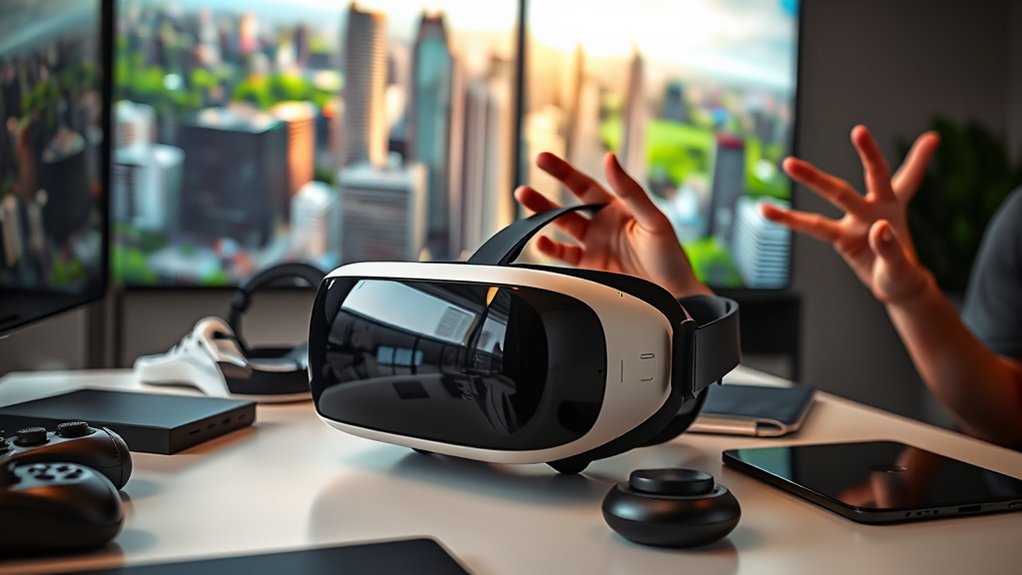
You’ve seen how VR can turn work from something on a screen into something you stand inside—but none of that matters if the numbers don’t work.
For attractions, you’re looking at $100,000–$300,000 for hardware, content, and installation, but those setups can earn $40,000–$100,000 per month and often break even within 18 months, especially in strong locations.
Operational costs stay low: fewer staff, smaller footprint than coasters, and mostly software-based updates.
For training, upfront VR runs higher—about $106,000 total, or $327.78 per person versus $229.79 for traditional methods.
Yet over three years, amortized costs drop to $115.43 per trainee as you reuse content. You avoid expensive physical setups and reduce accidents.
Mixed reality deployments like HoloLens 2 show 177% ROI with 13‑month payback.
Partnering for content reduces development risk and lets you scale while turning a fixed investment into compounding efficiency gains.
Conclusion
Virtual reality isn’t just a cool gadget—it’s a tool that can reshape how you learn, work, play, and connect. When you step into a headset, you’re stepping into hands-on training, deeper focus, new worlds, and experiences you couldn’t reach otherwise. If you weigh the costs, motion comfort, and time you’ll spend using it, you can decide if VR’s growing benefits are worth investing in for your goals and lifestyle.